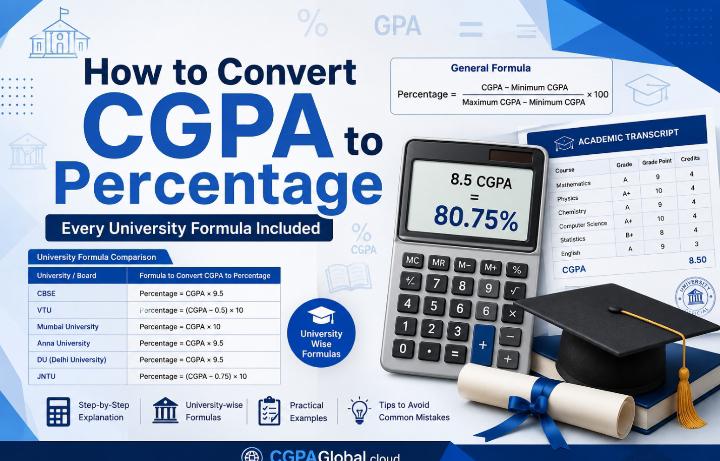

How to Convert CGPA to Percentage (Every University Formula Included) – Complete 2026 Guide
To convert CGPA to percentage, multiply your CGPA by a university-specific factor. Most Indian boards use CGPA × 9.5 (CBSE, Delhi University), while technical universities like VTU and JNTU use (CGPA − 0.75) × 10 or (CGPA − 0.5) × 10. There is no single universal formula — each institution sets its own official conversion rule, so always check your marksheet or examination circular first.
If you have ever stared at your marksheet wondering what your 8.2 CGPA actually means in percentage terms, you are not alone. Every application season, thousands of students hit the same wall: a scholarship portal, a job application, or a study-abroad form asks for a percentage, and all they have is a grade point average.
The frustrating part is that the internet is full of calculators that quietly assume one formula fits every university. It doesn't. A CGPA of 8.0 can mean 76% at one institution and 72.5% at another, purely because of how each university calibrates its grading scale. Get the wrong formula on a job application, and you could either undersell your results or, worse, list a number that doesn't match your official transcript.
This guide walks through exactly how CGPA-to-percentage conversion works, why the formulas differ, and gives you the specific calculation used by CBSE, VTU, Anna University, Mumbai University, JNTU, Delhi University, and several others — along with worked examples, a full conversion table, and answers to the questions students ask most.
What Is CGPA?
CGPA stands for Cumulative Grade Point Average. It is a way of summarizing academic performance across an entire course or program using a single number, usually on a 10-point scale (though some institutions use 4-point or 7-point scales). Instead of reporting raw marks for every subject, your results are converted into letter grades, each grade carries a grade point, and your CGPA is the credit-weighted average of those grade points across all semesters.
Most Indian universities calculate CGPA using this general formula:
So a subject with more credit hours pulls more weight in your final CGPA than a subject with fewer credits. This is why two students with visually similar grades can end up with slightly different CGPAs — the credit structure of their coursework matters just as much as the grades themselves.
What Is Percentage in Academic Grading?
Percentage marks are the traditional way of reporting academic performance: marks scored out of the total marks available, expressed on a 0–100 scale. Before CGPA systems became widespread, percentage was the default way every mark sheet, resume, and application form reported results.
Percentage is an absolute measure — it tells you exactly how many marks out of 100 you earned. CGPA, by contrast, is a relative, banded measure, since a wide range of raw marks can fall inside a single grade point. That difference is the entire reason a conversion formula is needed in the first place, and it's also why the conversion is only ever an approximation, not a perfect mathematical mirror of your original marks.
CGPA vs Percentage: What's the Difference?
It helps to see the two systems side by side before getting into the formulas.
| Aspect | CGPA | Percentage |
|---|---|---|
| Scale | Typically 0 to 10 | 0 to 100 |
| Type of measurement | Relative / grade-banded | Absolute / marks-based |
| Precision | Lower — groups scores into bands | Higher — reflects exact marks |
| Where it's common | Modern Indian universities, CBCS system | Traditional boards, most global admissions forms |
| Comparability | Harder to compare across institutions | Easier for direct comparison |
Can Every CGPA Be Converted into Percentage?
In principle, yes — but not with one universal number. Every CGPA can be mapped to an approximate percentage, but the accuracy of that mapping depends entirely on which formula your university has officially adopted. CGPA is a compressed version of your original marks, so any conversion back to percentage is an estimate calibrated to how that particular institution grades.
This is why autonomous universities, national boards, and accreditation bodies each publish their own conversion circular. A university with stricter grading bands (where you need 90%+ marks to get a top grade) will typically use a formula that subtracts a small buffer before multiplying, so the converted percentage doesn't overstate performance compared to a university with more generous grade bands.
The Standard CGPA to Percentage Formula
If your institution hasn't published its own formula, the most widely used default — originally popularized by CBSE — is:
This 9.5 multiplier isn't arbitrary. CBSE derived it by studying several years of student performance data. Students who earned the top grade (A1, marks between 91 and 100) averaged around 95 marks. Since A1 corresponds to a grade point of 10, dividing 95 by 10 gives exactly 9.5 — and that became the anchor for the entire scale.
This 9.5 rule works well as a rough estimate for many general-degree universities, but it is not universal. Technical universities in particular often use a subtraction-based formula instead, which we'll cover next.
Why Different Universities Use Different Conversion Formulas
Students are often surprised to learn there isn't one official master formula across India. The reason comes down to how differently each institution calibrates its grading bands.
Autonomous universities set their own internal assessment structure, grade boundaries, and credit systems. Because their grade-point-to-marks mapping doesn't match the CBSE model, applying CBSE's 9.5 multiplier to their CGPA would produce an inaccurate, usually inflated, percentage.
National boards like CBSE apply a single formula uniformly across all affiliated schools, which is why the ×9.5 rule is so consistent and well-documented for Class 10 results.
Accreditation and technical education bodies — the frameworks that many engineering universities align with — tend to set stricter mark-to-grade thresholds (for example, requiring 90%+ for the top grade instead of CBSE's 91%+ band being roughly equivalent). Universities operating under these frameworks typically subtract a buffer (0.5 or 0.75) before multiplying by 10, to keep the converted percentage aligned with how tough their actual grading is.
The practical takeaway: never assume your university uses the "standard" formula. Confirm it against your official grade card, academic regulations document, or examination department circular before submitting a converted percentage anywhere important.
University-Wise CGPA to Percentage Formulas
Here is a breakdown of the formulas most commonly cited as official for a range of Indian universities and boards. Formulas can be revised between regulation years, so always cross-check with your current academic regulations document.
CBSE Formula
CBSE's Class 9 and 10 CGPA converts using the standard multiplier:
Example: a CGPA of 8.4 converts to 8.4 × 9.5 = 79.8%. This formula is documented in CBSE's official guidelines and applies specifically to the Class 9–10 grading period, since Class 12 results are reported directly in marks and percentage rather than CGPA.
VTU Formula
Visvesvaraya Technological University uses a subtraction-based formula for its 2015, 2017, and 2018 schemes:
Example: a CGPA of 8.0 converts to (8.0 − 0.75) × 10 = 72.5%. This is published directly on the VTU official website. Newer VTU schemes (2021, 2022) may carry slightly different regulation numbers, so students should confirm their scheme year against their grade card before applying this formula.
Mumbai University Formula
The University of Mumbai's CBCS 10-point scale has commonly used:
Example: a CGPA of 8.5 converts to (7.1 × 8.5) + 11 = 71.35%. Some engineering streams and older regulations have used a slightly different constant (7.25 or 7.4 instead of 7.1). Because Mumbai University periodically revises its examination circulars, students should request an official conversion certificate from the university's examination section for anything used in a formal application.
Anna University Formula
Anna University's most widely cited official conversion, per its Controller of Examinations circulars, is a direct multiplier:
Example: a CGPA of 8.2 converts to 8.2 × 10 = 82%. Note that some regulation years and third-party sources cite a subtraction-based variant instead, so R2013, R2017, and R2021 students should verify against the current circular from the Anna University Controller of Examinations office before using this on an official document.
APJ Abdul Kalam Technological University
KTU (Kerala) follows a UGC-aligned 10-point CBCS grading structure. Most affiliated colleges apply the standard multiplier formula of CGPA × 9.5 as a working estimate, though KTU's own academic regulations should be treated as the final word — students should check their specific B.Tech or M.Tech regulation document via the university's official examination portal for the precise published conversion.
Delhi University
Delhi University's Examination Branch has used the CBSE-style multiplier for its CBCS-pattern courses:
Example: a CGPA of 8.5 converts to 8.5 × 9.5 = 80.75%. Interestingly, even a perfect 10.0 CGPA converts to 95%, not 100% — a detail that surprises a lot of DU students. This formula applies to SOL and NCWEB streams as well as the main campus colleges, since all follow the same Examination Branch circular.
JNTU
Jawaharlal Nehru Technological University (Hyderabad, Kakinada, and Anantapur campuses) uses a subtraction-based formula, though the exact buffer has varied by regulation year:
Percentage = (CGPA − 0.75) × 10 (older regulations, R15/R16)
Example under the newer formula: a CGPA of 8.5 converts to (8.5 − 0.5) × 10 = 80%. Because JNTUH, JNTUK, and JNTUA have each issued separate notifications over the years, students should check their specific B.Tech Academic Regulations document (usually referenced by clause number) to confirm which buffer applies to their batch.
Other Universities
Beyond these examples, dozens of other Indian universities publish their own CGPA-to-percentage formulas. The table below summarizes the most commonly cited conversion methods so you can compare at a glance — but always confirm against your own institution's current circular.
| University | Commonly Cited Formula | CGPA 8.0 Example |
|---|---|---|
| CBSE (Class 9–10) | CGPA × 9.5 | 76.0% |
| Delhi University | CGPA × 9.5 | 76.0% |
| VTU | (CGPA − 0.75) × 10 | 72.5% |
| JNTU (R18 onward) | (CGPA − 0.5) × 10 | 75.0% |
| Anna University | CGPA × 10 | 80.0% |
| Mumbai University | (7.1 × CGPA) + 11 | 67.8% |
| Generic UGC default | CGPA × 9.5 | 76.0% |
Notice how the same 8.0 CGPA lands anywhere between 67.8% and 80% depending purely on which formula applies. That's a 12-point spread on identical academic performance — which is exactly why using the wrong university's formula on an application form is one of the costliest mistakes a student can make. For a closer look at how this plays out for a specific national system, see our detailed breakdown of the India CGPA to percentage guide covering every formula.
CGPA to Percentage Conversion Table
Here's a quick-reference table using the standard ×9.5 multiplier, the most commonly used default across boards and general-degree universities. If your institution uses a different formula, apply the multiplier from the section above instead.
| CGPA | Percentage (× 9.5) |
|---|---|
| 4.0 | 38.0% |
| 4.5 | 42.75% |
| 5.0 | 47.5% |
| 5.5 | 52.25% |
| 6.0 | 57.0% |
| 6.5 | 61.75% |
| 7.0 | 66.5% |
| 7.5 | 71.25% |
| 8.0 | 76.0% |
| 8.5 | 80.75% |
| 9.0 | 85.5% |
| 9.5 | 90.25% |
| 10.0 | 95.0% |
Step-by-Step Guide to Convert CGPA into Percentage
- Locate your CGPA on your official marksheet, transcript, or grade card.
- Identify your university's official formula. Check your academic regulations document, examination circular, or the official university website — do not assume the standard ×9.5 rule applies.
- Apply the formula exactly as published, keeping decimal precision rather than rounding your CGPA first.
- Round your final result to two decimal places unless your institution specifies otherwise.
- Cross-check against your official conversion certificate if one is available — most universities issue these on request through the examination department.
- Use the converted percentage consistently across all forms for a given application, rather than mixing CGPA and percentage on the same document.
Worked Examples
Let's walk through a few real conversions using different official formulas, so you can see exactly how the math plays out for common CGPA values.
- 6.8 CGPA (CBSE-style, × 9.5): 6.8 × 9.5 = 64.6%
- 7.5 CGPA (VTU formula): (7.5 − 0.75) × 10 = 67.5%
- 8.2 CGPA (Anna University formula): 8.2 × 10 = 82%
- 9.1 CGPA (JNTU, newer regulation): (9.1 − 0.5) × 10 = 86%
- 9.8 CGPA (Delhi University formula): 9.8 × 9.5 = 93.1%
Notice the spread again: identical-looking CGPA values produce meaningfully different percentages once you factor in each university's own calibration. This is exactly why quoting a bare CGPA number without specifying the formula creates ambiguity on international applications.
Common Mistakes Students Make
- Using the wrong university's formula. Copy-pasting a generic ×9.5 or ×10 calculator result without checking your own institution's circular is the single most common error.
- Converting SGPA instead of final CGPA. Submitting a strong final-semester SGPA instead of your overall CGPA creates a mismatch with official records that verifiers can catch.
- Rounding too early. Rounding your CGPA before applying the formula (instead of after) can shift your final percentage by a noticeable margin.
- Assuming CGPA and percentage are interchangeable. They measure performance differently, and treating a 9.0 CGPA as "90%" almost always overstates your actual score.
- Not requesting an official conversion certificate when the stakes are high — visa applications, WES evaluations, or scholarship submissions usually expect this documentation rather than a self-calculated number.
When Should You Convert CGPA to Percentage?
Conversion becomes necessary in a handful of recurring situations:
| Situation | Why It Matters |
|---|---|
| Scholarships | Many scholarship portals set eligibility cutoffs in percentage, not CGPA — see our notes on Mastercard Foundation Scholars Program eligibility. |
| Government jobs | Public sector application forms typically ask for percentage marks directly. |
| Higher education | Admissions committees abroad often need a percentage or GPA equivalent for eligibility screening. |
| Visa applications | Some study visa checklists require academic percentage as a supporting document. |
| Employment | Recruiter application systems and ATS forms frequently have a percentage-only field. Read more on whether GPA matters to employers. |
Do Universities Abroad Accept CGPA or Percentage?
This varies significantly by country, and it's one of the most common points of confusion for students applying internationally.
- USA: Most graduate programs ask for a GPA on a 4.0 scale. Credential evaluators like World Education Services (WES) convert your transcript directly rather than relying on a self-reported percentage.
- Canada: Similar to the US — WES or ICAS evaluations are standard, and many Canadian universities will accept either CGPA or percentage as long as it's backed by an official transcript.
- UK: UK universities typically map international results to their own classification bands (First Class, Upper Second, etc.), so percentage is usually the more directly comparable figure. See our guide on personal statements for UK universities for related application context.
- Australia: Most Australian institutions request a percentage or GPA equivalent and will often recalculate it themselves from your transcript during assessment.
- Germany: German universities use their own 1.0–4.0 grading scale (1.0 being the best), and typically require a formal grade conversion — not a simple percentage. Our German grade to GPA converter guide covers this scale in detail, and it pairs well with our resource on studying in Germany with a Nigerian or Indian degree.
Should You Convert CGPA Yourself?
For casual reference — checking eligibility before you apply, or getting a rough sense of where you stand — calculating your own percentage using the official formula is perfectly fine.
For anything formal, though, self-calculated numbers usually aren't sufficient. Most universities issue an official transcript or a dedicated CGPA-to-percentage conversion certificate through their examination department, and this is the document that visa offices, employers, and credential evaluators expect to see. A self-calculated percentage can help you understand your standing, but it should not replace the university's own attested figure on a document that will be formally verified.
How Our CGPA to Percentage Calculator Makes It Easier
Manually tracking down the right formula for your specific university — and re-doing the math correctly every time you need it — gets tedious fast, especially with subtraction-based formulas that are easy to compute wrong under pressure. Our CGPA to Percentage Calculator is built to remove that friction: select your university (or the generic UGC-default formula if yours isn't listed), enter your CGPA, and get an instantly calculated, correctly rounded percentage — along with a note reminding you to verify against your official transcript before using it on formal documents.
It's designed for the exact moment you're filling out a scholarship form or a job application and need a fast, formula-accurate number rather than a generic one-size-fits-all guess.
Frequently Asked Questions
What is the formula for CGPA to percentage?
There isn't one universal formula. The most common default is Percentage = CGPA × 9.5 (used by CBSE and Delhi University), but many technical universities use a subtraction-based formula like (CGPA − 0.75) × 10. Always confirm the formula your specific institution has officially published.
Can every university use the same formula?
No. Each university calibrates its grading bands differently, so a formula that's accurate for one institution can overstate or understate your percentage at another. Autonomous universities and technical institutions in particular tend to publish their own conversion circulars.
How do I convert 8.2 CGPA?
It depends on your university. Using the standard ×9.5 formula, 8.2 CGPA equals 77.9%. Using Anna University's ×10 formula, it equals 82%. Using VTU's (CGPA − 0.75) × 10 formula, it equals 74.5%.
Is CGPA better than percentage?
Neither is objectively "better" — they're different ways of representing the same underlying performance. CGPA groups marks into bands and can be easier to compare within a cohort, while percentage gives a more precise, marks-based figure that's often easier to interpret internationally.
What is 7.5 CGPA in percentage?
Using the standard ×9.5 formula, 7.5 CGPA equals 71.25%. Using VTU's formula, it equals 67.5%. Using Anna University's ×10 formula, it equals 75%. The exact figure always depends on your institution's official conversion method.
Can employers ask for percentage?
Yes, and many do — particularly for eligibility screening in applicant tracking systems that have a numeric percentage field rather than a CGPA field. It's worth having your officially converted percentage ready alongside your CGPA when applying for jobs.
How do scholarship bodies calculate grades?
Most scholarship programs specify a minimum percentage or CGPA cutoff directly in their eligibility criteria, and many accept an official university conversion certificate as proof. Some programs also perform their own internal conversion using standardized international grading tables.
Does WES convert CGPA?
Yes. World Education Services evaluates your official transcript directly and applies its own credential evaluation methodology rather than relying on a self-reported percentage, which is one reason a formal WES evaluation can sometimes differ slightly from a manually calculated conversion.
Can I convert CGPA manually?
Yes, as long as you use your institution's correct, currently published formula. Manual conversion is fine for personal reference and quick eligibility checks, but formal applications generally require an official transcript or conversion certificate.
Why are conversion formulas different?
Because each university sets its own grade-point-to-marks calibration. Institutions with stricter grading bands typically subtract a buffer before multiplying by 10, so the converted percentage doesn't overstate performance relative to how difficult it actually is to earn top grades there.
Final Thoughts
The safest path is simple: find your university's officially published formula before you convert anything, apply it precisely, and keep an official conversion certificate on hand for any submission that will be formally verified — visa applications, WES evaluations, or scholarship portals in particular. A five-minute check against your academic regulations document can save you from a mismatch that costs far more time to fix later.
If your institution isn't covered in detail above, start with the generic ×9.5 estimate to get a rough sense of where you stand, then confirm the exact figure with your examination department before using it anywhere official. And if you're applying internationally, pair your converted percentage with your original CGPA and a note of the formula used — that combination gives admissions officers and employers everything they need to evaluate your record accurately, whatever grading system they're used to. For students weighing how a strong CGPA translates internationally, our piece on the Nigerian First Class international equivalent and our guide to studying smarter in your first semester abroad are worth reading next — along with our breakdown of common Chevening Scholarship application mistakes if scholarships are part of your plan.

Be the first to comment on this guide.
Leave a Comment
Comments are reviewed before appearing. Your email is never published.