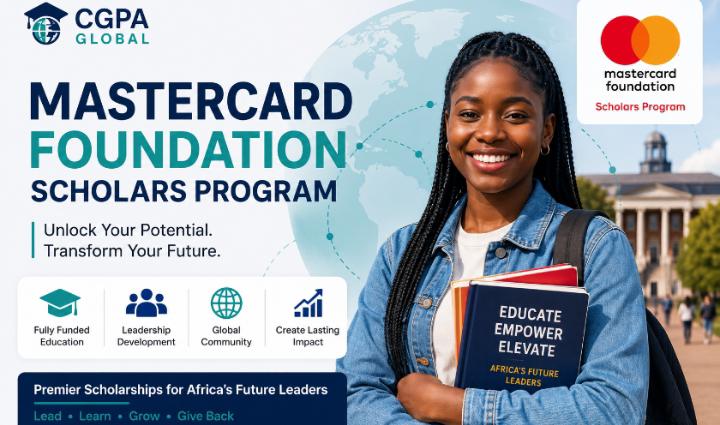

The Mastercard Foundation Scholars Program is one of the world's most competitive fully funded scholarship opportunities for African students. While thousands of applicants focus almost entirely on achieving excellent grades, successful candidates understand that academic performance alone rarely secures a scholarship. This guide explains what reviewers genuinely look for, who is eligible, the mistakes that eliminate otherwise strong applications, and practical strategies that can significantly improve your chances of receiving a fully funded scholarship in 2026.
The Mastercard Foundation Scholars Program is a fully funded scholarship for academically talented students from Africa who have demonstrated leadership potential, financial need, and a strong commitment to creating positive change in their communities. Selection is based on much more than GPA. Reviewers evaluate your academic ability, leadership experience, personal resilience, community impact, career vision, and whether your long-term goals align with the Foundation's mission of transforming lives through education.
What Is the Mastercard Foundation Scholars Program?
Every year, thousands of African students dream of studying at some of the world's most respected universities but never apply because they assume the cost is simply impossible to afford. Tuition fees, accommodation, travel expenses, books, insurance, and daily living costs quickly add up to amounts that are beyond the reach of many families.
The Mastercard Foundation Scholars Program was created to remove those financial barriers for exceptional students who have the talent to succeed but lack the resources to pursue higher education.
Unlike many scholarships that simply pay university tuition, the Mastercard Foundation Scholars Program is designed as a long-term leadership initiative. It aims to develop future professionals, entrepreneurs, researchers, educators, innovators, and community leaders who will contribute meaningfully to Africa's development after completing their studies.
Students admitted through the programme often receive comprehensive support that may include tuition fees, accommodation, books, meals, medical insurance, travel costs, leadership development opportunities, mentoring, internships, networking events, and career guidance. The exact benefits vary slightly depending on the partner university.
Rather than operating one central application portal, the Foundation works through selected partner universities across Africa, Europe, North America, and other regions. Each university manages its own admissions process and scholarship selection according to the Foundation's principles.
This means applicants should always read the specific requirements published by their chosen university instead of assuming that every institution follows exactly the same process or eligibility criteria.
Why This Scholarship Is Different From Most Others
Many scholarships reward students primarily for achieving outstanding grades. While strong academics certainly matter, the Mastercard Foundation Scholars Program takes a broader view of potential.
The programme recognises that intelligence alone does not automatically create lasting social impact. Many brilliant students never receive opportunities because of financial hardship, while others overcome extraordinary obstacles that cannot be reflected by examination results alone.
As a result, reviewers are interested in understanding who you are as a person, not simply what appears on your transcript.
Imagine two applicants who both graduated with excellent grades.
The first applicant lists academic achievements, awards, and certificates but provides little evidence of helping others outside the classroom.
The second applicant has similar grades but also organised free tutoring sessions for secondary school students, volunteered with a local health campaign, mentored younger students, and explains how those experiences inspired a long-term goal of improving educational access within their community.
Although both applicants may satisfy the academic requirements, the second application demonstrates the leadership mindset and community commitment that align much more closely with the Foundation's mission.
This emphasis on service is one reason many successful applicants continue volunteering long before and long after submitting their scholarship applications.
Who Is Actually Eligible?
Eligibility requirements differ slightly across partner universities, but several themes appear consistently throughout the programme.
- Applicants should demonstrate strong academic performance.
- They should show genuine financial need or significant socioeconomic barriers.
- Leadership potential should be visible through real actions rather than impressive-sounding titles.
- Community service, volunteering, mentoring, advocacy, or social initiatives strengthen an application considerably.
- Applicants should demonstrate a clear desire to contribute to the development of their home communities after graduation.
One common misconception is that only students with perfect grades receive the scholarship.
In reality, academic excellence is only one piece of the overall assessment.
For example, a student graduating with a slightly lower GPA but possessing years of meaningful community involvement may present a stronger overall application than someone whose transcript is flawless but whose experiences outside the classroom are extremely limited.
If you're still working to improve your academic performance before applying for scholarships, developing better study habits can make a noticeable difference. Our guide on how to study smarter during your first semester abroad shares practical learning strategies that remain useful whether you're preparing for local university examinations or international postgraduate study.
What Reviewers Really Look For
One of the biggest mistakes applicants make is assuming reviewers are searching for the "perfect student."
They are not.
Instead, they are searching for applicants whose experiences suggest they will use education to create opportunities for others rather than simply advancing their own careers.
From reviewing publicly available selection guidance and successful scholar profiles, four characteristics consistently stand out.
1. Authentic Financial Need
Financial need should never be exaggerated or dramatised. Instead, explain your circumstances honestly and support your story with evidence where appropriate.
Specific examples are far more convincing than broad statements like "my family struggled financially."
Describe challenges factually, explain how they affected your educational journey, and show how you continued progressing despite those difficulties.
2. Leadership Through Action
Leadership is not limited to serving as student union president or holding prestigious positions.
Reviewers frequently value applicants who quietly solve problems within their communities, organise initiatives, mentor younger students, teach digital skills, coordinate environmental projects, or support vulnerable groups.
Leadership is ultimately measured by influence and impact rather than titles.
3. Long-Term Vision
Successful applicants usually explain not only what they want to study but also why that education matters to the communities they hope to serve.
Whether your ambition involves improving healthcare, strengthening agricultural productivity, expanding access to quality education, developing sustainable businesses, or advancing technology, reviewers want to understand how your university education connects to measurable long-term impact.
4. Academic Readiness
Strong grades remain important because they demonstrate your ability to succeed in demanding university programmes.
If you're applying with a CGPA rather than percentages, ensure you understand how your academic results translate internationally. Our comprehensive guide on converting CGPA to percentage using official university formulas explains the differences between grading systems commonly requested during scholarship applications.
A Realistic Example of a Competitive Applicant
Consider Amina, a fictional but realistic applicant from northern Nigeria.
She graduated with a strong CGPA in Agricultural Engineering. During university, she volunteered with a local organisation that trained small-scale farmers on affordable irrigation techniques and helped secondary school students prepare for science examinations during school holidays.
Instead of writing a personal statement that simply said, "I want to improve agriculture in Africa," she described the water management challenges facing farming communities in her state, explained how climate change was affecting food production, identified specific research being conducted at her chosen university, and outlined how she hoped to adapt those solutions for rural communities after graduation.
Notice what made her application compelling.
It wasn't only her grades.
It was the clear connection between her past experiences, present ambitions, and future plans to create measurable community impact.
Typical Scholarship Benefits
| Benefit | What It Usually Covers |
|---|---|
| Tuition Fees | Full payment of eligible academic tuition. |
| Accommodation | University housing or approved living expenses. |
| Living Allowance | Support for meals and essential daily expenses. |
| Travel | Flights to and from the host country where applicable. |
| Health Insurance | Medical insurance during the study period. |
| Leadership Development | Mentorship, networking, workshops, and professional development opportunities. |
The "Giving Back" Essay: Where Many Strong Applications Win or Lose
Almost every Mastercard Foundation Scholars Program application asks some variation of the same question:
"How will your education help transform your community?"
At first glance, this sounds straightforward. Many applicants respond by saying they want to reduce poverty, improve healthcare, strengthen education, create jobs, or contribute to Africa's development. While these ambitions are admirable, they are also extremely common.
The challenge is that scholarship reviewers read hundreds—sometimes thousands—of essays each application cycle. Generic promises quickly blend together. What captures attention is a thoughtful, believable plan that connects your past experiences with your future goals.
Instead of writing:
"I want to return to Nigeria and improve education."
A stronger response might explain the specific problem you've witnessed, the work you've already begun, the knowledge you hope to gain at university, and how you intend to apply that knowledge after graduation.
For example, if you've volunteered as a mathematics tutor for students in underserved communities, explain how that experience exposed gaps in educational resources. Then describe how studying education technology, curriculum development, or data science could help you design practical learning solutions for those communities in the future.
The strongest essays rarely promise to change an entire country overnight. Instead, they demonstrate a realistic understanding of one problem and explain how the applicant hopes to contribute meaningful, long-term solutions.
If your application requires a personal statement, you may find our detailed guide on writing a winning personal statement for UK universities useful. Although it focuses on university admissions, many of the same storytelling principles apply to scholarship essays.
Common Mistakes Applicants Make
Every application season, many capable students are rejected not because they lack potential, but because they make avoidable mistakes that weaken otherwise competitive applications.
Here are some of the most common:
| Common Mistake | A Better Approach |
|---|---|
| Writing generic essays. | Use personal experiences supported by specific examples. |
| Listing achievements without explaining impact. | Show how your activities benefited other people. |
| Applying close to deadlines. | Prepare documents several months in advance. |
| Ignoring university-specific instructions. | Tailor every application to the selected institution. |
| Focusing only on grades. | Balance academics with leadership and community service. |
One lesson appears repeatedly across major international scholarship programmes: instructions matter. Something as simple as exceeding a word limit, uploading the wrong document format, or failing to answer every part of an essay prompt can significantly reduce your chances of progressing to the next stage.
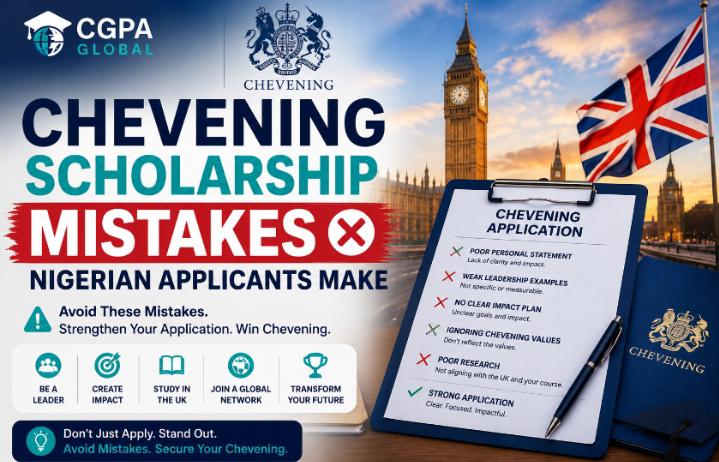
Applicants considering multiple scholarships should also read our guide on common Chevening Scholarship mistakes Nigerian applicants should avoid. Although the scholarships differ, many of the application errors are surprisingly similar.
GPA vs Leadership vs Community Impact
A question that appears every year is whether GPA is the most important factor in receiving a Mastercard Foundation Scholarship.
The answer is no—but it still matters.
Think of your application as a three-legged stool.
- Academic performance demonstrates that you can succeed in a demanding university programme.
- Leadership shows your ability to influence and inspire others.
- Community impact provides evidence that you already use your skills to improve the lives of people around you.
If one of these areas is missing entirely, your application becomes less competitive.
For example, a student with an outstanding GPA but no evidence of leadership may struggle to convince reviewers that they will maximise the opportunities provided by the scholarship. Likewise, a passionate community volunteer whose academic preparation is too weak may find it difficult to satisfy university admission requirements.
The strongest candidates demonstrate balance across all three areas.
If you're unsure how your CGPA translates into percentage during international applications, our guide on official CGPA-to-percentage conversion formulas explains how universities use different grading systems around the world.
Application Timeline
Unlike many scholarship schemes that operate through a single central portal, the Mastercard Foundation Scholars Program follows the admission schedules of its individual partner universities.
That means application periods vary throughout the year.
In many cases, universities begin accepting applications several months before the academic year starts, with deadlines commonly falling between October and January for programmes beginning the following year.
Because every university sets its own schedule, applicants should monitor the official admissions pages of their preferred institutions rather than relying on unofficial websites or social media posts.
Preparing early also gives you sufficient time to request recommendation letters, complete language examinations where required, gather financial documentation, and revise scholarship essays carefully before submission.
Some Universities That Partner With the Mastercard Foundation
The list of participating institutions changes over time as new partnerships are announced. However, the programme has supported scholars at universities such as:
- University of Toronto (Canada)
- McGill University (Canada)
- Sciences Po (France)
- Ashesi University (Ghana)
- University of Pretoria (South Africa)
- University of Edinburgh (selected programmes)
- USIU-Africa (Kenya)
- African Leadership University (selected partnerships)
Always confirm current partner institutions through the official university websites because eligibility requirements and available programmes may change over time.
Step-by-Step Strategy for Building a Competitive Application
- Research partner universities that align with your academic interests.
- Read every scholarship requirement carefully before beginning your application.
- Prepare certified academic documents well in advance.
- Develop meaningful leadership and community service experiences instead of collecting certificates.
- Write multiple drafts of your essays and ask trusted mentors for constructive feedback.
- Submit your application well before the deadline to avoid technical issues.
- Continue volunteering and improving your skills even after submitting your application.
Remember that scholarships reward consistent effort over time. Community impact cannot be created in a single weekend simply to strengthen an application.
Frequently Asked Questions
Is the Mastercard Foundation Scholars Program fully funded?
Yes. Successful scholars generally receive comprehensive financial support that may include tuition, accommodation, living expenses, books, travel, health insurance, and leadership development opportunities. The exact benefits vary by partner university.
Do I need a perfect GPA?
No. Strong academic performance is important, but reviewers also evaluate leadership, financial need, resilience, community involvement, and future impact.
Can postgraduate students apply?
Many partner universities offer opportunities for both undergraduate and postgraduate applicants, although eligibility depends on the institution and programme.
Can I apply to multiple partner universities?
In many cases, yes, provided you satisfy each university's eligibility requirements and submit separate applications where required.
Final Thoughts
The Mastercard Foundation Scholars Program is about far more than funding a university education. It is an investment in individuals whose experiences, leadership, and ambitions suggest they will create lasting positive change within their communities.
Excellent grades certainly strengthen your application, but they represent only one part of the bigger picture. Authentic leadership, meaningful community service, resilience in the face of challenges, and a clearly defined vision for the future often distinguish successful scholars from equally qualified applicants.
As you prepare your application, focus less on trying to sound impressive and more on telling your genuine story with clarity, evidence, and purpose. Reviewers are looking for potential they can believe in—not perfection.
If you're planning to study abroad beyond this scholarship, you may also benefit from our guides on studying in Germany with a Nigerian or Indian degree and whether GPA really matters to employers after your first job. Together, these resources can help you make informed decisions throughout your academic and professional journey.
Be the first to comment on this guide.
Leave a Comment
Comments are reviewed before appearing. Your email is never published.