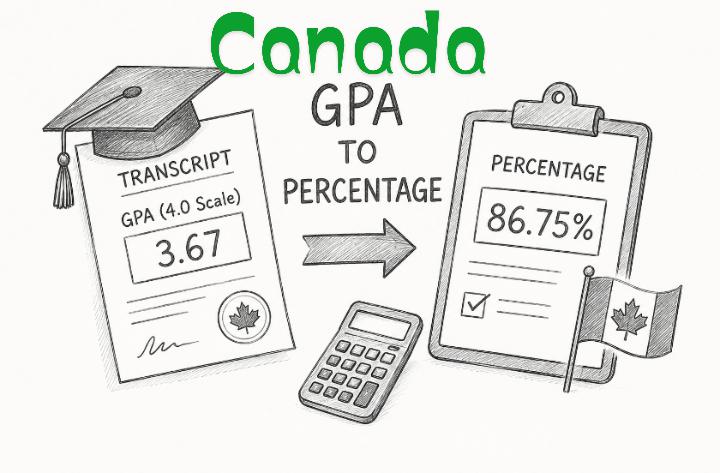

Canada GPA to Percentage Calculator (2026 Guide): Convert Your Canadian GPA Easily
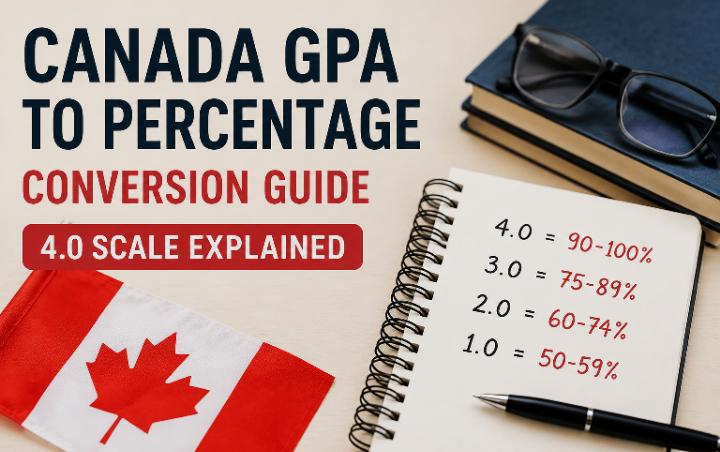
To convert a Canadian GPA to a percentage, first check which scale your school uses (4.0, 4.33, or 4.3), then match your GPA to the closest letter grade band on that scale's official conversion table. There is no single formula every university accepts, because Canada has no national grading standard. The safest method is letter-grade matching, not straight multiplication.
If you have ever stared at your Canadian transcript wondering what your 3.6 GPA actually means in percentage terms, you are not alone. I have worked with students from Lagos, Mumbai, Manila, and Toronto itself who all asked the same question in different words: "What is my GPA really worth?"
The honest answer is that Canada does not have one grading system. Every province, and often every university within a province, sets its own scale. A 3.7 GPA at the University of Toronto does not mean exactly the same thing as a 3.7 GPA at the University of British Columbia, because the two schools do not even use the same maximum GPA value. This guide walks through why that happens, how to convert your GPA to a percentage correctly, and where students most often get it wrong.
What Is the Canadian GPA System?
A Grade Point Average, or GPA, is a single number that summarizes how a student performed across all their courses, weighted by how many credits each course was worth. In most countries, one national body sets the scale. Canada works differently. Higher education falls under provincial jurisdiction, not federal control, and each province leaves grading policy up to the individual university.
Why Canada doesn't have one standard GPA scale
Because Canadian universities operate independently and provinces do not coordinate grading policy, you end up with several parallel systems running at the same time. Some schools cap their top grade at 4.0. Others let an A+ climb to 4.33. A few report performance as a straight percentage average and never convert to GPA points at all. None of these approaches is "more correct" than another; they are simply different institutional choices.
This matters more than it sounds. A graduate admissions committee reading two transcripts side by side, one from Ontario and one from British Columbia, cannot assume the numbers mean the same thing unless they know which scale produced them. That is exactly why credential evaluators and admissions offices ask applicants to state the scale alongside the number, for example "3.8 out of 4.33 (UBC scale)" rather than just "3.8 GPA."
Common GPA scales used by Canadian universities
Three scales dominate the Canadian landscape, along with a handful of variations at specific institutions:
- The 4.0 scale — used by most Ontario universities. A+ and A are both capped at 4.0, meaning there is no extra reward for scoring 95% instead of 86%.
- The 4.33 scale — common in British Columbia. A+ is given its own point value above the standard A, so exceptional performance is reflected more precisely.
- The 4.3 scale — used by several French-language universities in Quebec, functioning similarly to the 4.33 scale but with slightly different rounding conventions.
- Percentage-only reporting — some schools, including McGill and the University of Waterloo, report your transcript primarily as a percentage average rather than a GPA at all, though a GPA-equivalent is often available on request for external applications.
Quebec's CEGEP system adds another layer entirely. Instead of GPA, it uses the "cote de rendement au collégial" or R-Score, a relative performance measure rather than a raw grade conversion. If you are coming from a CEGEP background, treat the R-Score as a separate metric rather than something you can plug into a GPA formula. For a deeper breakdown of how Indian percentage-based CGPA compares to Canadian conventions, see our guide on India CGPA to percentage, every formula explained.
How to Convert Canada GPA to Percentage
Here is where most online calculators oversimplify the problem. They treat GPA-to-percentage conversion as a single algebraic formula, when in reality the honest approach runs through letter grades first.
Conversion formulas explained
There are two broad approaches, and it helps to know when each one applies.
Method one: letter-grade matching (recommended). Every Canadian university publishes an official table mapping percentage ranges to letter grades and letter grades to GPA points. Instead of converting a raw GPA number into a percentage mathematically, you work backward through the letter grade. If your transcript shows a B+ and your university's calendar states that B+ equals 76–79%, then your percentage equivalent sits somewhere in that band. This is the method registrars and credential evaluators actually use, because it respects each institution's own grading philosophy rather than forcing a generic formula onto it.
Method two: the approximate algebraic formula. When no letter-grade breakdown is available, a commonly used rough approximation is:
Percentage ≈ (GPA × 12.5) + 50
GPA ≈ (Percentage − 50) ÷ 12.5
This formula assumes a 4.0 scale and a passing threshold around 50%, which is common at Canadian universities but not universal. Treat it as a starting estimate for informal purposes, such as gauging roughly where you stand, rather than a number you would submit on an official form. Scholarship committees, immigration authorities, and graduate admissions offices generally want the letter-grade method or an official credential evaluation, not a formula-derived estimate.
If you are converting a 4.33-scale GPA down to a standard 4.0 scale for comparison purposes, a simple ratio works reasonably well:
4.0-scale equivalent = (Your GPA ÷ 4.33) × 4.0
So a 4.0 GPA on UBC's 4.33 scale translates to roughly 3.69 on a standard 4.0 scale. That difference of 0.31 points can matter quite a bit when a scholarship or program sets a hard cutoff like "minimum 3.7 GPA."
Step-by-step conversion example
Let's walk through a realistic case. Amara, a student at a British Columbia university, wants to know her percentage average from her transcript.
- Step 1: She pulls her official course grades: A (85%), A+ (92%), B+ (78%), A- (81%), and B (73%).
- Step 2: Because she has the actual percentages on her transcript, she does not need to guess. She calculates a simple average: (85 + 92 + 78 + 81 + 73) ÷ 5 = 81.8%.
- Step 3: If her transcript only showed letter grades and GPA points instead of percentages, she would look up UBC's official conversion table, find the percentage band for each letter grade, and use the midpoint of that band as her estimate.
- Step 4: If she needs a credit-weighted result because her courses carry different credit values, she multiplies each grade by its credit weight, sums the products, and divides by total credits, rather than using a plain average.
Notice that step 2 was possible only because her actual percentage marks were available. Whenever your institution provides raw percentages alongside letter grades, always use the percentages directly. They are more accurate than reverse-engineering a percentage from a rounded GPA number.
Canada GPA to Percentage Conversion Table
Below are two commonly used reference tables. Treat these as general guides rather than official documents; always confirm the exact bands with your institution's academic calendar or registrar's office, since percentage cutoffs can shift by a point or two between schools.
4.0 GPA scale
| Letter Grade | Percentage Range | GPA Points |
|---|---|---|
| A+ | 90–100% | 4.0 |
| A | 85–89% | 4.0 |
| A- | 80–84% | 3.7 |
| B+ | 77–79% | 3.3 |
| B | 73–76% | 3.0 |
| B- | 70–72% | 2.7 |
| C+ | 67–69% | 2.3 |
| C | 63–66% | 2.0 |
| D | 53–59% | 1.0 |
| F | Below 50% | 0.0 |
4.33 GPA scale
| Letter Grade | Percentage Range | GPA Points |
|---|---|---|
| A+ | 90–100% | 4.33 |
| A | 85–89% | 4.0 |
| A- | 80–84% | 3.67 |
| B+ | 76–79% | 3.33 |
| B | 72–75% | 3.0 |
| B- | 68–71% | 2.67 |
| C+ | 64–67% | 2.33 |
| C | 60–63% | 2.0 |
| D | 50–59% | 1.0–1.67 |
| F | Below 50% | 0.0 |
Notice the key structural difference between the two tables. On the 4.0 scale, A and A+ collapse into the same grade point, so scoring 91% earns you nothing extra over scoring 86%. On the 4.33 scale, that extra effort is rewarded with a distinct, higher point value. If you are applying internationally and your target school compares raw GPA numbers without asking which scale you used, you could be at a disadvantage purely because of which province you studied in, not because of weaker academic performance. This is one of the most misunderstood details in Canadian transcript evaluation, and it is worth raising directly with an admissions officer if you are ever unsure.
GPA Scales Used by Popular Canadian Universities
Knowing the general scales is useful, but specific universities are where students usually get tripped up, especially when applying to more than one school at once.
University of Toronto
U of T uses the standard 4.0 scale. A+ and A both max out at 4.0 grade points, even though A+ typically represents 90% and above while A covers roughly 85–89%. The university's Dean's List recognition generally requires a sessional GPA around 3.5 or higher, though exact thresholds can vary by faculty and program. If you are aiming for a specific Dean's List cutoff, check your faculty's academic calendar directly rather than relying on a university-wide number, since Arts & Science, Engineering, and professional faculties sometimes apply slightly different rules.
University of British Columbia
UBC is the most commonly cited example of the 4.33 scale in Canada. An A+ here earns 4.33 points rather than being capped at 4.0, which means UBC students who consistently score in the 90s see that reflected more precisely in their cumulative average. UBC calls its academic distinction list the "Dean's Honour Roll" rather than Dean's List, and eligibility typically depends on standing within the top portion of a faculty for a given year, alongside a minimum course load. If you are converting a UBC GPA for an application to a school using the 4.0 scale, remember to apply the ratio adjustment described earlier rather than comparing the raw numbers directly.
McGill University
McGill's official transcript reports grades primarily as percentages and letter grades, not as a GPA out of 4.0 or 4.33. For external applications, particularly to US graduate schools, McGill provides a grade-point equivalent on request, generally following an A = 4.0, A- = 3.7, B+ = 3.3 style mapping. McGill's academic distinction, the Principal's Honour List, is generally reserved for students carrying a full course load with a very high sessional average. Because McGill leans on percentage reporting, if you are a McGill student converting your grades for a scholarship application, start from your actual percentage average rather than trying to back into one from an unofficial GPA conversion.
University of Waterloo
Waterloo is one of the clearest examples of a Canadian university that reports academic performance as a straight percentage average rather than a GPA. Course grades appear as percentages on the transcript, and your cumulative average is also a percentage. Students applying to graduate programs or scholarships that specifically request a GPA figure typically need to either ask the receiving institution to interpret the percentage directly, or use a conversion tool that maps Waterloo's percentage bands onto a 4.0-equivalent scale. If you are weighing where to study and want to understand how a strong first-class average abroad compares, our piece on the Nigerian first-class degree and its international equivalent is a useful companion read.
Common Mistakes When Converting Canadian GPA
I have reviewed enough transcripts and scholarship applications to notice the same handful of errors coming up repeatedly. Here are the two that cause the most damage.
Assuming every university uses the same scale
This is, by far, the most common and most costly mistake. A student compares a 3.6 GPA from one Canadian school with a 3.6 GPA from another and assumes they represent equal performance. If one school uses the 4.0 scale and the other uses 4.33, those two numbers are not directly comparable, because the ceiling itself is different. The fix is simple but easy to forget under application deadline pressure: always state the scale next to the number, and check whether the institution you are applying to expects a normalized figure.
Ignoring letter-grade equivalents
Some students convert a percentage to a GPA using a generic formula, skipping the letter-grade step entirely. This can produce a misleadingly precise-looking number that does not match what the university's own scale would actually assign. For example, a formula might suggest that 84% converts cleanly to a 3.4 GPA, when the university's official table places 84% inside the A- band worth 3.7 points. Always check the official conversion table for the specific institution before trusting a generic algebraic result, especially for anything going on an official application.
Why GPA to Percentage Conversion Matters
This is not just an academic exercise. Getting the conversion right, or wrong, has real consequences.
Scholarships
Many scholarship programs set a hard minimum GPA or percentage cutoff. If a scholarship requires "a minimum of 80%" and your transcript shows a 3.3 GPA, you need to know with confidence whether that GPA clears the bar before you invest hours in an application. Misjudging this in either direction wastes time, or worse, causes a strong candidate to skip an opportunity they actually qualified for. If you are researching prestigious opportunities, our breakdown of common Chevening Scholarship mistakes Nigerian applicants make covers several GPA-related pitfalls that apply broadly to competitive scholarship applications, and our guide to the Mastercard Foundation Scholars Program walks through eligibility expectations for another major award.
Graduate admissions
Graduate programs, especially competitive ones like medical school, engineering master's programs, or MBA programs, often apply their own conversion logic to every applicant's transcript rather than trusting the applicant's self-reported GPA. In Ontario, for instance, medical school applications processed through OMSAS apply a standardized conversion table to every transcript submitted, regardless of what scale the originating university used internally. This levels the playing field somewhat, but it also means your internal university GPA is not necessarily the number that decides your admission outcome.
Credential evaluations
If you are applying abroad, or if a Canadian employer or licensing body needs to verify your academic record, a credential evaluation service will typically convert your transcript to a standardized format. Services like WES (World Education Services) apply their own conversion tables, and the number that comes out the other end can differ from what you calculated yourself. Understanding roughly how the conversion works helps you anticipate what a formal evaluation is likely to show, rather than being surprised by the result. For students weighing a move to continental Europe as an alternative path, our comparison of the German grade to GPA converter shows how differently European institutions structure the same underlying idea.
Use the Free Canada GPA to Percentage Calculator
Manually working through letter-grade tables is fine for a single check, but if you are converting a full transcript with a dozen courses at different credit weights, a calculator saves real time and reduces the chance of a manual arithmetic slip.
How the calculator works
A well-built Canada GPA to percentage calculator asks you to select your institution's scale first, either 4.0, 4.33, or percentage-only, because that choice determines every subsequent calculation. From there, you enter either your letter grades or your raw percentage marks alongside the credit weight of each course. The tool multiplies each grade point by its credit weight, sums the results, and divides by your total credits to produce a weighted GPA, then maps that figure back onto an estimated percentage range using the scale you selected at the start.
The most useful calculators also let you flip the process, entering a target GPA or percentage and seeing what letter-grade combination would be required to reach it. This is genuinely helpful for students planning their final semester and trying to figure out exactly what grades they need in their remaining courses to hit a scholarship or graduate admission threshold.
When to trust the results
A calculator is reliable for personal planning, rough estimates, and understanding where you stand relative to a target cutoff. It is not a substitute for an official transcript or a formal credential evaluation when the stakes are high, such as a scholarship application, a graduate school submission, or a professional licensing requirement. In those situations, always request an official document from your registrar, or a formal evaluation from a recognized service, and treat the calculator's output as a sanity check rather than the final word. If your career plans hinge on how graduate employers actually read your transcript, it is also worth reading whether GPA really matters to employers, since the answer varies more by industry than most students expect.
Frequently Asked Questions
Is a 3.7 GPA good in Canada?
Yes, generally. On a 4.0 scale, a 3.7 typically corresponds to an A- average, roughly 80–84%, which is considered strong at almost every Canadian university and competitive for most graduate programs. On a 4.33 scale, a 3.7 sits slightly below the equivalent A- band, since the scale's proportions shift, so context still matters.
What percentage is a 4.0 GPA?
On the standard 4.0 scale, a 4.0 GPA usually corresponds to a percentage range between 85% and 100%, since both A and A+ grades are capped at 4.0 points. On the 4.33 scale, a 4.0 GPA specifically represents the A band, roughly 85–89%, because A+ performance is assigned a higher 4.33 value instead.
Do all Canadian universities use the same grading system?
No. Canada has no single national grading standard. Ontario schools generally use the 4.0 scale, British Columbia schools commonly use the 4.33 scale, and some Quebec institutions rely on percentage-based reporting with a 4.3-style GPA equivalent available for external use. Always check your specific institution's academic calendar.
Which GPA scale should I use?
Use whichever scale your institution officially reports on your transcript. If you need to compare your GPA against a scale used by another school or country, convert using the ratio method described earlier, and clearly label which scale each number belongs to so admissions committees are not misled by an apparent mismatch.
How is Canadian GPA calculated when courses have different credit values?
You multiply each course's grade point value by its credit weight, add those results together across all your courses, and divide by the total number of credits attempted. This is called a credit-weighted GPA, and it is the standard method used at virtually every Canadian university, since a 6-credit course should count more heavily than a 3-credit one.
Can I convert my Indian CGPA to a Canadian percentage?
Yes, though it typically goes through an intermediate step. Indian CGPA on a 10-point scale is usually first converted to a percentage using your university's own multiplier, then compared against Canadian percentage bands. Our detailed walkthrough on converting India CGPA to percentage using every common formula covers this conversion path in depth.
Does a failed course still count in my Canadian GPA?
Generally, yes. An F typically carries a 0.0 grade point value and is included in your cumulative GPA calculation, which is why a single failed course can drag down an otherwise strong average significantly. Some universities allow grade replacement if you retake the course, but policies differ, so check your institution's academic regulations directly.
What is the passing percentage at Canadian universities?
Most Canadian universities set the undergraduate passing threshold at 50%, though this can rise to 60% for some graduate-level courses or specific programs. Quebec's CEGEP system also generally uses a 60% pass threshold ahead of university admission.
How does OMSAS calculate GPA for medical school applications?
OMSAS, which processes Ontario medical school applications, applies its own standardized 4.0-scale conversion to every course on every transcript submitted, including repeated courses, regardless of the scale your home university used internally. This means your internal university GPA and your OMSAS GPA can differ noticeably.
Is the R-Score the same as a GPA?
No. The R-Score used in Quebec's CEGEP system is a relative performance measure that adjusts for the academic strength of your peer group and course difficulty, not a direct percentage or GPA conversion. It should be treated as a separate admissions metric.
Why does my GPA look lower on an international application than it does at home?
This usually happens when a receiving institution interprets your GPA using its own scale's assumptions rather than the scale your Canadian university actually used. A 3.8 out of 4.33 can be misread as a 3.8 out of 4.0 if you do not clearly label the scale, which understates your actual academic standing. Always state the scale explicitly on international applications.
Should I include my percentage or my GPA on a scholarship application?
Include both when the form allows it, along with a note specifying your institution's grading scale. If the form only asks for one, provide whichever number your official transcript emphasizes, and attach a brief explanation of the scale if there is room, since scholarship committees reviewing applicants from multiple countries appreciate the clarity.
Putting This Into Practice
Before you submit any application that depends on your GPA or percentage, take five minutes to do three things: confirm which scale your specific institution uses by checking the academic calendar or registrar's page, match your grades against the official letter-grade table rather than a generic formula, and label the scale explicitly whenever you report your GPA on an external form. These three habits prevent the vast majority of conversion errors students run into, and they take far less time than untangling a misunderstanding after a scholarship committee has already made its decision.
If you are heading into your first term abroad and want a broader head start beyond grade conversion, our guide on studying smarter in your first semester abroad and our advice on writing a personal statement for UK universities are both worth bookmarking alongside this one, and if Germany is on your shortlist, studying in Germany with a Nigerian or Indian degree lays out exactly how your existing grades get recognized there.

Be the first to comment on this guide.
Leave a Comment
Comments are reviewed before appearing. Your email is never published.