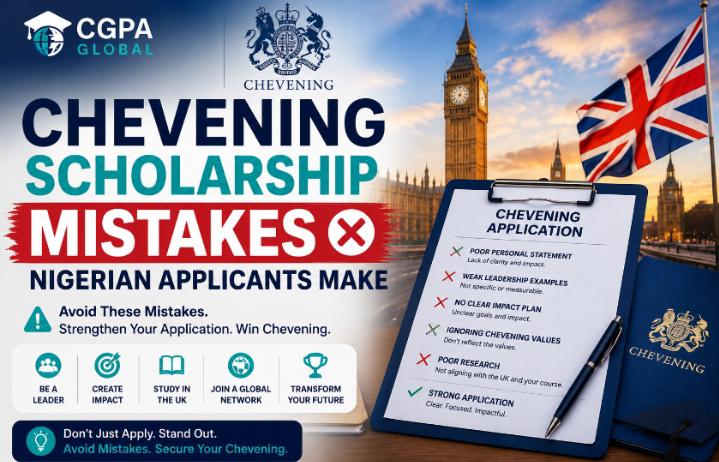

The Numbers Behind Chevening
Each year, approximately 1,500 Chevening Scholarships are awarded globally. Nigeria consistently ranks among the top recipient countries, with hundreds of Nigerian applicants receiving awards annually. However, competition is intense — acceptance rates are typically around 1–2% of total applicants.
Understanding this context is not discouraging — it is clarifying. Most rejections are not because candidates lacked academic strength. They were rejected because of specific, fixable mistakes in how they presented themselves.
Mistake 1: Writing Generic Leadership Essays
The Chevening leadership essay asks you to demonstrate leadership experience. The most common error is describing a generic leadership role ("I was president of the student union...") without connecting it to a specific outcome, a specific lesson, and a specific vision for the future.
Shortlisted applicants write about a specific moment that revealed something unexpected about leadership — and they connect that moment to why they need the Chevening programme specifically.
Mistake 2: Choosing the Wrong Three Universities
Chevening requires you to apply to three UK universities before applying for the scholarship. Many applicants choose based on prestige alone (Oxford, Cambridge, LSE) without checking whether their first-choice programme is genuinely competitive for their background. If your three choices are all extremely selective and your profile is marginal for each, your application looks either delusional or poorly researched.
The strongest applications show a strategic spread: one ambitious target, one good fit, and one realistic safety — all with genuine academic and professional justification.
Mistake 3: Underusing the Networking Essay
The Chevening networking essay is where most Nigerian applicants lose the most points relative to their actual potential. Chevening's core value proposition is its alumni network — 50,000+ leaders in over 160 countries. The networking essay tests whether you understand this.
Weak answers: "I will attend events and make connections." Strong answers: name specific Chevening alumni in your field, describe how their work connects to yours, and explain what you bring to the network — not just what you want to take from it.
Mistake 4: Ignoring the Post-Study Return Requirement
Chevening explicitly requires scholars to return to their home country for a minimum of two years after completing their studies. Applications that do not address this requirement — or worse, hint at intentions to remain in the UK — are immediately disqualifying.
Every essay should reinforce your commitment to returning and contributing. This is not a bureaucratic requirement to mention once; it is the philosophical heart of what Chevening does.
Mistakes 5–7: Timeline, References, and Re-Application
Mistake 5: Submitting in the final week. Applications submitted in the last few days before the deadline are evaluated under pressure. Submitting six to eight weeks early gives you time to revise, get feedback, and correct errors.
Mistake 6: Choosing referees who cannot speak to leadership. Chevening referees must attest to your leadership potential. A professor who has only assessed your academic work cannot do this as effectively as a supervisor, employer, or community leader who has observed you in a leadership context.
Mistake 7: Not applying after a first rejection. Chevening explicitly encourages reapplication. Many successful scholars applied two or three times. Each application teaches you what to improve.
Checkout this guides
Enrich your knowledge with our carefully sorted educational guides covering CGPA and GPA conversion, international admissions, scholarships, study abroad, and academic success.
- How to Convert CGPA to Percentage (Every University Formula Included)
- India CGPA to Percentage Conversion: Every Official University Formula Explained
- German Grade to GPA Converter: Convert German Grades to International GPA
- Nigerian First Class Degree International Equivalent Explained
- Studying in Germany with a Nigerian or Indian Degree: Complete Guide
- How to Write a Winning Personal Statement for UK Universities
- Mastercard Foundation Scholars Program: Eligibility, Benefits & Application Guide
- How to Study Smarter During Your First Semester Abroad
- Does GPA Matter to Employers? What Recruiters Really Look For


Be the first to comment on this guide.
Leave a Comment
Comments are reviewed before appearing. Your email is never published.