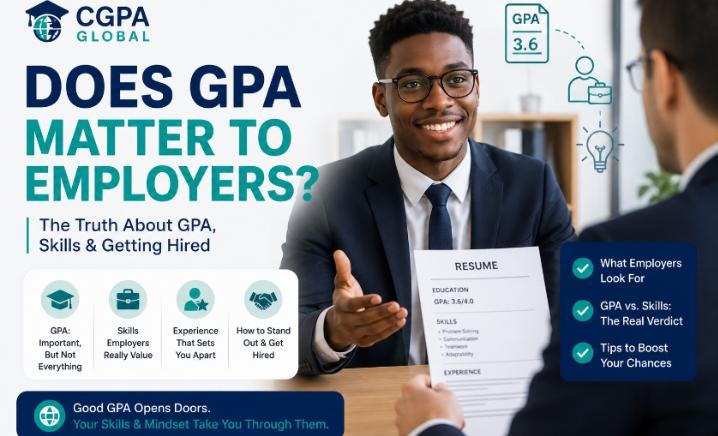

Your GPA matters most when you're applying for internships, graduate schemes, scholarships, or your first professional job. After you've gained two to five years of relevant work experience, most employers place much greater value on your achievements, technical skills, leadership, portfolio, and professional track record than your university grades.
Few questions make recent graduates more anxious than whether their university GPA will continue to influence their careers long after graduation. If you've ever wondered whether a 3.2 GPA will stop you from landing your dream job—or whether employers still care about your grades five years into your career—you're asking a question that millions of graduates around the world ask every hiring season.
The truth is more nuanced than the simple "yes" or "no" answers often found online. Different employers evaluate candidates differently, industries have their own hiring traditions, and your GPA gradually becomes less important as your professional experience grows. A graduate applying for an investment banking analyst programme will likely face a very different hiring process from someone applying for a software engineering role at a growing startup or a marketing position at a local business.
In this guide, you'll learn when employers genuinely care about GPA, when it stops influencing hiring decisions, which industries still use academic cut-off points, and what you should focus on if your grades aren't where you hoped they would be. You'll also see real-world hiring scenarios, practical advice for presenting your academic record, and common mistakes graduates make during job applications.
Why Employers Ask for GPA in the First Place
For many students, it can feel frustrating to spend years developing practical skills only to discover that some employers still request a university GPA. However, understanding why companies ask for academic performance helps explain when—and why—it actually matters.
For graduate recruiters, GPA acts as an early screening tool rather than a complete measure of someone's ability. Large employers often receive thousands of applications for a few dozen graduate positions. Reviewing every application individually would be extremely time-consuming, so recruiters sometimes use minimum academic requirements to reduce the number of applications before conducting interviews.
A strong GPA can also suggest qualities that employers value, including:
- Consistency over several academic years.
- The ability to manage deadlines and multiple responsibilities.
- Strong analytical and problem-solving skills.
- Discipline and commitment to long-term goals.
- The ability to learn complex information quickly.
Of course, GPA isn't a perfect predictor of workplace success. Someone may graduate with average grades while building businesses, volunteering extensively, leading student organisations, or completing impressive personal projects. Many employers understand this, which is why GPA is only one part of a much bigger picture.
The Honest Answer Depends on Four Important Factors
Whether your GPA influences an employer's hiring decision depends largely on four key factors:
| Factor | Why It Matters | Typical Employer View |
|---|---|---|
| Industry | Some industries remain academically competitive. | Finance and consulting often care more than creative industries. |
| Career Stage | Experience gradually replaces academic performance. | After several years, achievements become the priority. |
| Country | Hiring practices differ internationally. | Government roles often place greater emphasis on classifications. |
| Employer Recruitment Process | Large organisations usually have structured screening systems. | Small businesses often focus on skills and personality. |
Understanding these four factors helps explain why two graduates with identical GPAs may receive very different responses from employers applying for different positions.
When GPA Definitely Matters
Although many experienced professionals eventually stop listing their GPA on their CV, there are still situations where employers pay close attention to academic performance.
Graduate Programmes and Campus Recruitment
Large multinational companies frequently receive tens of thousands of applications from recent graduates every year. Companies such as Goldman Sachs, JP Morgan, Morgan Stanley, McKinsey, Bain & Company, Boston Consulting Group, Procter & Gamble, Nestlé, and Unilever often establish minimum academic requirements before applicants reach the interview stage.
These requirements aren't necessarily intended to exclude capable candidates. Instead, they help recruiters manage exceptionally high application volumes fairly and consistently.
| Career Area | Typical Importance of GPA | Reason |
|---|---|---|
| Investment Banking | Very High | Extremely competitive graduate recruitment. |
| Management Consulting | Very High | Strong analytical performance is heavily evaluated. |
| Government Graduate Roles | Moderate to High | Academic classifications are often formal requirements. |
| Technology Startups | Low | Projects and technical ability usually matter more. |
| Creative Industries | Low | Portfolios often outweigh academic results. |
Scholarships and Postgraduate Admissions
If you're planning to continue your education rather than enter full-time employment immediately, your GPA may remain important for longer. Many postgraduate programmes, fully funded scholarships, and research opportunities include minimum academic requirements alongside other selection criteria.
For example, scholarship committees often review GPA together with leadership experience, volunteer work, research publications, recommendation letters, and personal statements. A high GPA alone rarely guarantees success, but it can strengthen an already competitive application.
If you're preparing for postgraduate applications, you may also find it helpful to understand how to convert CGPA to percentage using official university formulas, especially when application portals request percentages instead of grade points.
A Real Hiring Scenario
Case Study: Two graduates applied for the same graduate analyst programme.
Sarah graduated with a 3.86 GPA but had limited internship experience. Daniel graduated with a 3.18 GPA but completed two internships, built a financial modelling portfolio, and volunteered as the treasurer of a student organisation.
Both candidates passed the initial GPA screening because they met the company's minimum requirement. During interviews, however, recruiters focused far more on how each candidate solved problems, communicated ideas, worked with teams, and demonstrated practical business knowledge.
Daniel ultimately received the job offer—not because his GPA was higher, but because his experiences provided stronger evidence that he could perform successfully in the role. This illustrates an important lesson: once you satisfy an employer's minimum academic requirement, everything else on your application becomes increasingly important.
When GPA Stops Being the Main Hiring Factor
One of the biggest misconceptions among graduates is believing that their GPA will define their entire career. In reality, for most professions, its importance gradually declines after your first few years in the workforce. Once you've built a history of delivering results, employers become much more interested in what you've accomplished professionally than what you achieved academically.
Recruiters hiring experienced professionals typically ask questions such as:
- What measurable impact did you make in your previous role?
- Can you demonstrate leadership experience?
- Have you managed projects successfully?
- What technical skills have you developed?
- Can you solve real business problems?
- How well do you communicate and collaborate with teams?
Notice that none of these questions directly relate to university grades. Employers understand that workplace performance depends on many qualities that cannot be measured by GPA alone.
This shift is especially noticeable in industries such as software development, digital marketing, design, entrepreneurship, cybersecurity, and product management, where portfolios, certifications, completed projects, and practical experience often outweigh academic performance.
What Employers Usually Value More Than GPA
A competitive GPA may help you secure an interview, but it rarely guarantees a job offer. During interviews, employers evaluate a much broader range of qualities that demonstrate whether you can contribute to their organisation.
| Hiring Factor | Why Employers Value It |
|---|---|
| Relevant Work Experience | Shows you can apply knowledge in real workplace situations. |
| Internships | Demonstrates exposure to professional environments. |
| Projects & Portfolio | Provides tangible evidence of your abilities. |
| Communication Skills | Essential for teamwork, leadership, and client interaction. |
| Professional Certifications | Shows continuous learning beyond university. |
| Problem-Solving Ability | Employers hire people who can solve business challenges. |
Many hiring managers would rather recruit someone with average grades and exceptional practical experience than someone with outstanding grades but little evidence of applying their knowledge in real-world situations.
How to Present Your GPA on Your CV
There's no universal rule about whether you should include your GPA on your CV. The right decision depends on your academic performance, your career stage, and the type of position you're applying for.
| Your Situation | Recommendation |
|---|---|
| Excellent GPA (Top academic performer) | Include it prominently, especially during your early career. |
| Average GPA | Include it only if requested or if you have limited work experience. |
| Lower GPA with Strong Experience | Focus your CV on achievements, projects, and measurable results instead. |
| Five or More Years of Experience | Your employment history should usually take centre stage. |
If your university reports grades using CGPA rather than percentage, be careful not to convert them using unofficial formulas. Different institutions use different grading systems, so always follow your university's official conversion policy.
Common Mistakes Graduates Make
- Believing a low GPA automatically ends their career opportunities.
- Listing an incorrect percentage converted from CGPA.
- Ignoring internships while focusing only on academic performance.
- Failing to build a professional portfolio before graduation.
- Leaving leadership roles, volunteer work, and extracurricular achievements off their CV.
- Applying for jobs without tailoring their resume to each employer.
Many successful professionals didn't begin their careers with perfect academic records. What helped them progress was continuously developing new skills, gaining experience, and demonstrating measurable results.
Frequently Asked Questions
Does GPA matter after your first job?
Usually much less. Once you've gained relevant work experience, employers generally place greater emphasis on your professional achievements, technical skills, and career progression than your university grades.
Can a low GPA prevent me from getting hired?
It can affect opportunities with some graduate programmes that use minimum academic requirements. However, many employers consider internships, projects, certifications, portfolios, and interview performance alongside academic results.
Should I include my GPA on my resume?
If you're a recent graduate with strong academic performance, including your GPA can strengthen your application. Experienced professionals often choose to highlight work achievements instead.
Do technology companies care about GPA?
Some graduate programmes may consider GPA, but many technology employers place much greater importance on coding ability, technical interviews, open-source contributions, portfolios, and practical experience.
Is a First Class degree always better than experience?
No. A First Class degree demonstrates academic excellence, but employers also want evidence that you can perform effectively in a professional environment. Practical experience often becomes increasingly valuable as your career develops.
Can employers verify my GPA?
Yes. Some employers request official transcripts or degree verification during background checks, particularly for graduate programmes, regulated professions, and government positions.
Final Thoughts
Your GPA is best viewed as an opportunity opener rather than a lifelong career predictor. During the early stages of your career, it can help you qualify for internships, graduate schemes, scholarships, and competitive postgraduate programmes. However, as your professional experience grows, employers become far more interested in the value you create, the problems you solve, the people you lead, and the results you achieve.
If your grades are excellent, be proud to include them where they're relevant. If they aren't, don't assume your career ambitions are over. Invest in practical skills, build an impressive portfolio, earn respected certifications, gain meaningful experience, and continue learning throughout your career. Those achievements often become the strongest evidence of your ability long after graduation.
📚 Continue Learning
If you're exploring academic grading systems, international admissions, scholarships, or study abroad opportunities, these guides provide practical explanations, official grading insights, and expert tips to help you make informed decisions throughout your educational journey.
- How to Convert CGPA to Percentage (Every University Formula Included)
- India CGPA to Percentage Conversion: Every Official University Formula Explained
- German Grade to GPA Converter: Convert German Grades for International Applications
- Nigerian First Class Degree International Equivalent Explained
- Studying in Germany with a Nigerian or Indian Degree: Complete Guide
- How to Write a Winning Personal Statement for UK Universities
- Common Chevening Scholarship Mistakes Nigerian Applicants Should Avoid
- Mastercard Foundation Scholars Program: Eligibility, Benefits & Application Guide
- How to Study Smarter During Your First Semester Abroad
Be the first to comment on this guide.
Leave a Comment
Comments are reviewed before appearing. Your email is never published.