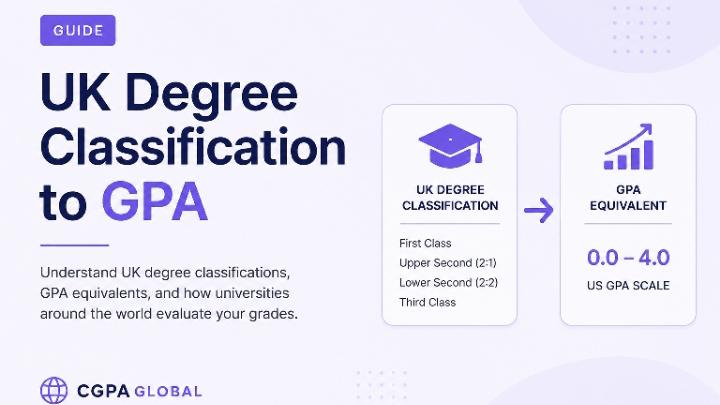

UK Degree Classification to GPA: The Complete 2026 Conversion Guide
Every year, thousands of students graduate from universities in the United Kingdom with a First Class, 2:1, 2:2, or Third Class degree, only to discover that universities, employers, and scholarship organisations outside the UK don't use these classifications. Instead, they ask for a GPA—usually on the American 4.0 scale. That's when confusion begins.
Can a UK First Class be called a 4.0 GPA? Is a 2:1 equivalent to a 3.5 GPA or a 3.0? Why do some universities say one thing while credential evaluation agencies say another?
The truth is that there isn't one universal conversion. Different universities, scholarship providers, employers, and credential evaluation agencies use different methods depending on their admission policies. Understanding these differences can prevent costly application mistakes and help you present your academic achievements accurately.
In this guide, you'll learn how UK degree classifications compare with the US GPA system, how universities actually evaluate UK transcripts, why percentage marks matter more than many students realise, and when you should avoid converting your degree altogether. We'll also explain the role of credential evaluation agencies, provide practical conversion examples, and answer the questions students ask most frequently.
What I thought!
There is no official universal conversion between a UK degree classification and a US GPA because UK universities award honours classifications while American universities use a cumulative Grade Point Average system.
As a general educational guide:
| UK Degree Classification | Approximate US GPA |
|---|---|
| First Class Honours | 3.7 – 4.0 |
| Upper Second Class (2:1) | 3.3 – 3.7 |
| Lower Second Class (2:2) | 2.7 – 3.2 |
| Third Class | 2.0 – 2.6 |
These ranges are educational estimates only. Many universities evaluate your official transcript directly rather than relying on a converted GPA.
The Conversation That Started It All
When I first started researching international grading systems, it wasn't because I planned to build an educational website. It began with a simple family conversation.
My younger brother had decided to pursue his master's degree in the United Kingdom. Like many international students, he assumed the hardest part would be choosing a university or preparing his visa documents. Instead, one unexpected question kept appearing on university websites:
"What is your GPA equivalent?"
At first, we thought the answer would be easy to find. After all, thousands of students move between countries every year. Surely there would be one accepted conversion that everyone uses.
The more we researched, however, the more confusing things became.
One website claimed that a UK First Class was always equivalent to a 4.0 GPA. Another suggested it was closer to 3.8. Some universities ignored GPA entirely and focused on percentages. Others required credential evaluations. Several articles copied the same conversion tables without explaining where the numbers actually came from.
Even after my brother eventually arrived in the UK, he told me that many of the assumptions we had made from reading websites were incomplete. Admissions teams often looked beyond a simple GPA conversion. They considered transcripts, grading standards, university reputation, and individual course performance—not just one number.
That experience eventually inspired the creation of CGPA Global.
Rather than repeating simplified conversion charts found across the internet, our goal is to explain why different countries use different grading systems and how admissions officers actually interpret academic records. Understanding the reasoning behind the conversion is often more valuable than the conversion itself.
Why UK Degrees Confuse International Students
If you've studied in the United States, Canada, India, Nigeria, Australia, or many other countries, you're probably familiar with cumulative GPA or CGPA systems. Students receive numerical values that can be averaged over several semesters to produce a final score.
The UK uses a completely different approach.
Instead of graduating with a GPA, students receive an honours classification based primarily on their final weighted academic performance. The exact weighting differs between universities, but the final award is generally presented as one of four major classifications.
- First Class Honours
- Upper Second Class Honours (2:1)
- Lower Second Class Honours (2:2)
- Third Class Honours
For students applying internationally, this creates a challenge because many application forms don't recognise these classifications. Instead, they ask for GPA values, percentages, or local grading scales.
This is one reason why many students also use our Nigerian First Class international equivalent guide and our German Grade to GPA converter guide to better understand how universities compare qualifications across different education systems.
Understanding UK Degree Classifications
Before attempting any GPA conversion, it's important to understand what each UK classification actually represents. Contrary to popular belief, these aren't simply percentage bands—they reflect different levels of academic achievement recognised throughout the UK higher education system.
You can learn more about how UK honours degrees are structured from UCAS
| Classification | Typical Percentage | General Performance |
|---|---|---|
| First Class | 70% and above | Outstanding academic performance with consistently excellent work. |
| Upper Second (2:1) | 60–69% | Strong academic achievement and the minimum requirement for many postgraduate programmes. |
| Lower Second (2:2) | 50–59% | Good overall performance with satisfactory subject knowledge. |
| Third Class | 40–49% | Meets the minimum honours degree requirements but may limit certain postgraduate opportunities. |
One important point that surprises many international applicants is that earning 70% in the UK is considered exceptional. Unlike some countries where top-performing students regularly score above 90%, UK universities traditionally award marks much more conservatively. A graduate with 72% may actually be among the strongest students in their cohort.
This difference in grading culture is one of the main reasons why direct percentage comparisons between countries can be misleading.
How UK Degree Classification to GPA Conversion Actually Works
One of the biggest misconceptions students have is believing there's a secret formula that converts every UK degree into a US GPA. Unfortunately, it doesn't work that way.
The UK's Quality Assurance Agency (QAA) explains how degree standards and academic classifications are maintained across UK higher education
Unlike converting kilograms to pounds or Celsius to Fahrenheit, academic grading systems are built around different educational philosophies. The UK honours classification system measures overall degree performance using classification bands, while the American GPA system calculates an average grade point earned across multiple courses throughout a programme.
That means converting between the two isn't a mathematical exercise—it's an academic interpretation.
When universities or credential evaluation agencies assess your qualification, they usually consider several factors together instead of relying on a single conversion table.
- Your final honours classification
- Your overall percentage or weighted average
- Your transcript and individual module results
- The grading practices of your university
- The competitiveness of your programme
- The admission requirements of the receiving institution
For example, two graduates may both earn an Upper Second Class (2:1), but one finishes with 60% while another graduates with 68%. Although they share the same classification, admissions officers understand that the second student performed much closer to a First Class standard.
This is one reason many universities ask applicants to upload their complete academic transcripts rather than simply entering a GPA.
Think of a UK honours classification as a summary of your academic performance, while a US GPA is an ongoing numerical average. Admissions officers often evaluate both differently, which is why your transcript usually carries more weight than an estimated GPA conversion.
WES vs Universities: Why Your GPA May Be Different
Students are often surprised when one university estimates their GPA differently from another. This usually happens because institutions aren't required to follow a single international conversion standard.
Some universities evaluate applications internally, while others rely on professional credential evaluation organisations such as World Education Services (WES) or similar agencies in their country.
Credential evaluation agencies examine far more than your final degree classification. They review:
- The official transcript
- Course credit hours
- Individual module grades
- The country's grading culture
- The awarding institution
- The structure of the qualification
Universities, on the other hand, sometimes skip GPA conversion altogether. Instead, they simply specify admission requirements such as:
- A UK First Class Honours degree
- A UK Upper Second Class (2:1)
- Its international equivalent
If you've noticed this wording while applying abroad, you're not alone. Many admissions teams prefer evaluating qualifications in their original form because it preserves important academic context.
This is similar to what we explained in our complete Germany study guide, where German universities often assess original transcripts instead of relying solely on converted GPAs.
Typical UK Percentage to GPA Comparison
Although there is no universally accepted conversion table, the following ranges represent how many international universities generally interpret UK percentages when estimating a US GPA.
| UK Percentage | Classification | Approximate GPA | General Interpretation |
|---|---|---|---|
| 70%+ | First Class | 3.7–4.0 | Outstanding academic performance |
| 65–69% | High 2:1 | 3.5–3.7 | Very competitive for postgraduate study |
| 60–64% | 2:1 | 3.3–3.5 | Strong academic performance |
| 50–59% | 2:2 | 2.7–3.2 | Satisfactory performance |
| 40–49% | Third Class | 2.0–2.6 | Minimum honours standard |
Remember that these ranges are educational estimates rather than official conversions. A university may assign a slightly different GPA depending on its evaluation process.
Common Mistakes Students Make
After reviewing hundreds of university admission pages and speaking with students preparing international applications, a few mistakes appear repeatedly.
- Assuming every First Class equals a perfect 4.0 GPA. In reality, many institutions evaluate transcripts rather than assigning an automatic 4.0.
- Converting your degree without reading the university's instructions. Some universities explicitly ask applicants not to convert their grades.
- Ignoring percentage marks. A student graduating with 69% may be assessed differently from someone with 60%, even though both hold a 2:1.
- Using random online conversion tables. Many websites publish oversimplified charts without explaining how they were created.
- Entering estimated GPAs on official application forms. When in doubt, always report your original classification if that's what the institution requests.
If you're converting grades from another country before applying internationally, you may also find our Indian CGPA to Percentage guide helpful, especially if your undergraduate studies were completed outside the UK.
How Employers Interpret UK Degrees
Outside the academic world, employers often care less about GPA conversion than many graduates expect.
Large multinational companies usually recognise UK honours classifications directly, especially if they regularly recruit international graduates.
Rather than asking whether your First Class equals a 3.9 or 4.0 GPA, recruiters are typically more interested in:
- Your degree classification.
- The university you attended.
- Your technical and professional skills.
- Internships and work experience.
- Leadership activities.
- Communication and problem-solving abilities.
In many industries, your classification simply helps demonstrate academic ability, while interviews and practical experience determine hiring decisions.
What About Master's Admissions?
Master's admissions are where UK degree classifications become particularly important.
Many universities around the world don't require applicants to calculate a GPA themselves. Instead, admission requirements often state something like:
- A UK Upper Second Class (2:1).
- A UK First Class Honours degree.
- Or an international equivalent.
Admissions officers then compare your original academic record with their own internal equivalency guidelines. This approach provides a more accurate picture of your academic performance than relying solely on an estimated GPA.
If you're planning postgraduate study, scholarships, or studying overseas, you'll also benefit from our guides on writing a strong UK personal statement and whether GPA really matters to employers, both of which explain how universities and recruiters evaluate applicants beyond numerical grades.
How UK Degree Classifications Compare With Other Countries
One reason UK degree classifications often cause confusion is that very few countries use the same honours system. Every education system has its own grading culture, scoring philosophy, and way of recognising academic achievement. A First Class degree may represent exceptional performance in the UK, but another country might express that same achievement using GPA, CGPA, percentages, or even descriptive grades.
This is exactly why international universities rarely compare grades by looking only at numbers. Instead, admissions officers evaluate the context behind those numbers.
| Country | Typical Grading System | Highest Academic Award | Comparable UK Classification |
|---|---|---|---|
| United Kingdom | Honours Classification | First Class | First Class |
| United States | 4.0 GPA | 4.0 GPA | Approximately First Class |
| Nigeria | 5.0 CGPA | First Class (4.50+) | UK First Class |
| India | 10 CGPA / Percentage | 9.0+ CGPA | Usually comparable to First Class |
| Germany | 1.0–5.0 (Inverse Scale) | 1.0 | Approximately First Class |
| Canada | 4.0 GPA | 4.0 GPA | Comparable to First Class |
| Australia | 7.0 GPA | 7.0 GPA | High First Class equivalent |
The important takeaway is that these comparisons are educational estimates. Universities rarely rely on broad comparison tables alone. Instead, they consider your transcript, course difficulty, grading standards, and institutional reputation before making admission decisions.
Real Conversion Examples
Let's look at a few realistic examples to understand how admissions officers might interpret UK qualifications.
Example 1: Applying to a US Master's Programme
Sarah graduates from the University of Manchester with a First Class Honours and an overall average of 74%.
The university she's applying to requests a minimum GPA of 3.5. Instead of asking Sarah to calculate her own GPA, the admissions office reviews her transcript and determines that her academic performance exceeds their minimum requirement.
Example 2: Scholarship Application
David graduates with an Upper Second Class (2:1) at 68%.
Although his classification is technically the same as someone graduating with exactly 60%, scholarship reviewers recognise that 68% places him much closer to a First Class standard. His strong transcript strengthens his application considerably.
Example 3: International Employment
A UK graduate applies for a graduate engineering role in Canada.
Rather than requesting a converted GPA, the employer asks for the original transcript. During recruitment, technical interviews, internships, and work experience carry significantly more weight than estimated GPA conversions.
How Top Universities Interpret UK Degree Classifications
One of the questions we receive most often at CGPA Global is:
"If Harvard asks for a 3.7 GPA, does my UK First Class automatically qualify?"
The short answer is not necessarily—but often, yes.
This is where many students accidentally overcomplicate their applications. Instead of trying to force every qualification into a perfect GPA equivalent, leading universities have dedicated admissions teams that understand international education systems.
Most universities publish their international entry requirements. For example, you can review the University of Oxford's graduate admissions requirements
They review thousands of applications from around the world every year and already know what a UK First Class, a Nigerian First Class, an Indian 9.0 CGPA, or a German 1.3 grade represents academically.
In other words, they usually don't expect applicants to "translate" their degree perfectly—the admissions office does that themselves.
| University | How UK Degrees Are Usually Evaluated | Typical Expectation |
|---|---|---|
| Harvard University | Original transcript reviewed alongside international equivalencies. | Usually First Class or strong 2:1. |
| Stanford University | Holistic review using transcript and academic background. | Competitive First Class or high 2:1. |
| University of Oxford | Uses UK classifications directly. | Normally First Class or strong Upper Second. |
| University of Cambridge | Evaluates original academic records. | Usually First Class. |
| University of Toronto | Reviews international grading standards internally. | Competitive 2:1 or above. |
| University of Melbourne | Considers honours classification and transcript together. | Upper Second or First Class. |
Notice something interesting?
Very few universities publicly publish a strict "UK First Class = 3.9 GPA" rule. Instead, they focus on whether your qualification meets their academic standard. That's why submitting your official transcript is almost always more important than calculating your own GPA.
A Better Way to Think About GPA Conversion
After researching grading systems from more than 50 countries while building CGPA Global, one pattern became obvious:
Students often become obsessed with finding one exact GPA number.
Admissions officers don't.
Imagine two students graduating with the exact same classification.
| Student A | Student B |
|---|---|
|
First Class Overall Average: 70% |
First Class Overall Average: 82% |
Technically, both students earned a First Class Honours degree.
Would admissions officers treat those applications exactly the same? Probably not.
Student B demonstrated consistently stronger academic performance across the programme, even though the classification itself is identical.
That's why universities review:
- Your transcript.
- Your overall percentage.
- The difficulty of your modules.
- Your final-year performance.
- Your research experience.
- Your recommendation letters.
- Your personal statement.
Your GPA—or estimated GPA—is only one small piece of a much bigger picture.
Planning to Study Abroad?
If you're preparing applications for the UK, USA, Canada, Germany, Australia, or another destination, these guides can save you hours of research:
- Studying in Germany with a Nigerian or Indian Degree
- Nigerian First Class International Equivalent
- How to Convert 10 CGPA to Percentage in Every Indian University
- Mastercard Foundation Scholars Program 2026
- Chevening Scholarship Mistakes Nigerian Applicants Make
- Personal Statement Guide for UK Universities
Whether you're comparing a UK honours degree with a US GPA, converting an Indian CGPA into a percentage, understanding the German grading system, or evaluating a Nigerian First Class degree, our goal remains the same:
To make international education easier to understand—one grading system at a time.
Frequently Asked Questions
Is a UK First Class equal to a 4.0 GPA?
Not officially. Many institutions consider a First Class roughly equivalent to a GPA between 3.7 and 4.0, but there is no internationally recognised conversion.
Can I calculate my GPA myself?
Only if the university specifically asks you to do so. Otherwise, report your original UK degree classification exactly as it appears on your transcript.
Do American universities understand UK degrees?
Yes. Most universities regularly receive applications from UK graduates and already have internal equivalency guidelines.
Will WES give me exactly the same GPA as another university?
Not necessarily. Credential evaluation agencies and universities may use different evaluation methods depending on the purpose of the assessment.
Does a 2:1 satisfy most postgraduate requirements?
Yes. Many master's programmes around the world list a UK Upper Second Class (2:1) or its international equivalent as the minimum admission requirement.
When You Should Not Convert Your GPA
Surprisingly, there are many situations where converting your degree yourself is unnecessary—or even discouraged.
- When the application specifically asks for your original transcript.
- When the university states that it performs its own credential evaluation.
- When an employer requests your honours classification rather than a GPA.
- When using professional evaluation services for immigration or licensing purposes.
- When scholarship providers explicitly ask applicants not to estimate their own GPA.
If you're unsure, it's almost always safer to report your original degree classification exactly as awarded by your university.
If you're planning to study in the UK as an international student, the UK Council for International Student Affairs (UKCISA) offers practical guidance on admissions, visas, and student life.
Your transcript is usually more valuable than any estimated GPA. Universities trust official academic records far more than unofficial online conversion calculators.
Final Thoughts
Converting a UK degree classification to GPA isn't about finding a perfect mathematical formula. It's about understanding how different education systems describe academic achievement.
Whether you've earned a First Class, a 2:1, a 2:2, or a Third Class degree, remember that universities and employers increasingly evaluate applicants holistically. Your transcript, research experience, leadership, personal statement, recommendations, internships, and professional achievements often matter just as much as your final classification.
That's why understanding your grades—and the context behind them—is far more valuable than relying on a single conversion number.
If you're preparing for postgraduate study, scholarships, or international employment, you'll also find these guides helpful:
- How to Write a Personal Statement for UK Universities
- Mastercard Foundation Scholars Program 2026
- Study Smarter During Your First Semester Abroad
- Does GPA Really Matter to Employers?
- German Grade to GPA Conversion Guide
Convert Your Grades with Confidence
Whether you're applying for a master's degree, preparing scholarship applications, or comparing grading systems across countries, CGPA Global helps you understand international academic equivalencies with practical guides and free conversion tools designed for students worldwide.
Use the Free Grade Converter →
Be the first to comment on this guide.
Leave a Comment
Comments are reviewed before appearing. Your email is never published.