
How to Convert 10 CGPA to Percentage in Every Indian University (Complete 2026 Guide)
A perfect 10 CGPA does not automatically equal 100%. The percentage depends entirely on your university's official conversion formula. CBSE converts 10 CGPA to 95%, VTU gives 92.5%, and Anna University commonly treats it as 100%. Always use your institution's official formula — not a generic one found online — when filling out job, scholarship, or university applications.
You worked hard for four years. You submitted every assignment, survived every examination cycle, and somehow walked away with a perfect 10 CGPA. Now you are filling out a job application, a scholarship form, or a study abroad document — and it asks for your percentage. You search online and get six different answers from six different websites, none of them agreeing with each other.
That confusion is not your fault. India does not have a single national CGPA-to-percentage formula. Every university — sometimes every academic regulation batch within the same university — uses its own conversion method. A 10 CGPA from VTU converts to a different percentage than the same score from Anna University or Mumbai University. Writing the wrong number on an application is not just embarrassing — it can cause verification failures with employers and rejection from foreign universities.
This guide covers every major Indian university's official formula, shows you exactly what 10 CGPA converts to at each institution, and tells you how to use that number correctly on applications, scholarship forms, and international admissions documents.
Does 10 CGPA Mean 100%?
For most Indian universities, the answer is no. This surprises a lot of students because it seems logical — if the maximum CGPA is 10, surely 10 out of 10 should mean 100%. But grading systems do not work that way.
CGPA is a grade point average, not a percentage score. When universities designed their CGPA systems, they created conversion formulas to map grade points back to approximate percentages. These formulas account for how marks were originally distributed, how grade boundaries were set, and what the historical passing standards looked like. The result is that a perfect 10 CGPA can convert to anywhere between 82% and 100% depending on which university issued your degree.
The only case where 10 CGPA equals 100% is at universities like Anna University that use a direct multiplication formula of CGPA × 10. Most others use a modified formula that produces a number below 100.
Why Every Indian University Uses a Different Formula
India's higher education system is decentralised. Unlike countries with a single national grading standard, Indian universities are autonomous bodies that set their own academic regulations under the broad framework of the University Grants Commission (UGC). When the UGC introduced the Choice Based Credit System (CBCS) in 2015, it recommended a grading framework but did not mandate a single CGPA-to-percentage conversion formula.
The result is a patchwork of conversion formulas across more than 1,000 universities and 42,000 colleges. Some universities adopted the CBSE multiplier of 9.5. Others built their own formulas based on their existing mark distributions. Engineering universities like VTU and JNTU created formulas specific to their grading boundaries. Autonomous colleges within the same university sometimes use different formulas from affiliated colleges.
To make things more complex, the same university may use different formulas for different regulation years. A student who graduated under JNTU's R16 regulation uses a different formula from a student who graduated under R18. This is why you must always check your specific academic regulation document — not just your university's general conversion guidelines.
Official Formulas Used by Major Indian Universities
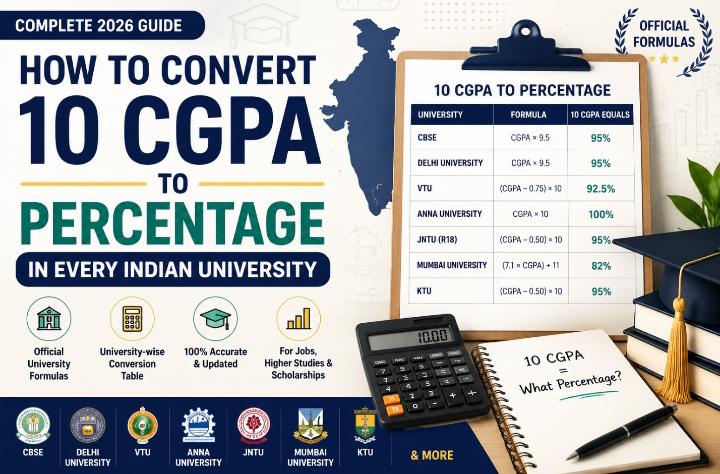
Below is a summary of the official conversion formulas used by the most common Indian universities, followed by detailed explanations for each.
| University | Official Formula | 10 CGPA Equals | Source |
|---|---|---|---|
| CBSE | CGPA × 9.5 | 95% | CBSE Official |
| VTU | (CGPA − 0.75) × 10 | 92.5% | VTU Official |
| Anna University | CGPA × 10 | 100% | Anna University Official |
| JNTU (R18) | (CGPA − 0.5) × 10 | 95% | JNTU-H Official |
| Mumbai University | (7.1 × CGPA) + 11 | 82% | MU Official |
| Delhi University | CGPA × 9.5 | 95% | DU Official |
| KTU | CGPA × 10 | 100% | KTU Official |
| Pune University | CGPA × 10 | 100% | SPPU Official |
| Osmania University | CGPA × 10 | 100% | OU Official |
| Calcutta University | CGPA × 10 | 100% | CU Official |
10 CGPA to Percentage in CBSE
The Central Board of Secondary Education uses a multiplier of 9.5 for converting CGPA to percentage. This formula was officially introduced by CBSE for Class 10 results and has since become the most widely cited conversion formula in India — though it applies specifically to CBSE, not to all universities.
For 10 CGPA: 10 × 9.5 = 95%
The reason CBSE chose 9.5 rather than 10 is rooted in how grades were awarded. Under the CBSE grading structure, a student scoring between 91 and 100 marks receives a grade point of 10. The midpoint of that range — 95.5 — was approximated to the 9.5 multiplier. So the formula is essentially converting grade points back to an estimated raw mark range, not declaring that 10 CGPA equals 100 out of 100 marks.
This is an important distinction. When you write 95% on a job application as a CBSE student with 10 CGPA, you are not rounding down — you are reporting the officially converted percentage as CBSE defines it.
10 CGPA to Percentage in Delhi University
Delhi University adopted the UGC's Choice Based Credit System and, for most programmes, uses the same CGPA × 9.5 formula that CBSE popularised. This means a DU student with a 10 CGPA converts to 95%.
For 10 CGPA: 10 × 9.5 = 95%
However, some autonomous colleges affiliated with Delhi University may use their own conversion formulas. If you studied at an autonomous college within DU, check your college's specific examination regulations before reporting a percentage. The safest option is always to request an official equivalence letter from your college's examination controller.
10 CGPA to Percentage in VTU
Visvesvaraya Technological University in Karnataka uses one of the most distinctive conversion formulas among Indian engineering universities. VTU subtracts 0.75 from the CGPA before multiplying by 10.
For 10 CGPA: (10 − 0.75) × 10 = 9.25 × 10 = 92.5%
The subtraction of 0.75 accounts for the fact that VTU's lowest passing grade point is 4.0, which corresponds to approximately 40 marks — a standard engineering passing threshold. The formula was calibrated so that a 4.0 CGPA produces a percentage close to 40%, maintaining consistency with VTU's historical mark-based evaluation.
This formula is consistent across most VTU regulations, but students from older VTU batches (pre-2015) should verify whether their specific academic year used a slightly different scale, as VTU revised its grading structure multiple times.
If you are a VTU graduate applying to study in Germany, note that German universities calculate their own admission grade (Zulassungsnote) using a separate formula. You can read more about how Indian degrees are evaluated in Germany in our guide on studying in Germany with an Indian degree.
10 CGPA to Percentage in Anna University
Anna University, which affiliates hundreds of engineering colleges across Tamil Nadu, uses a straightforward multiplication formula.
For 10 CGPA: 10 × 10 = 100%
Anna University is one of the few major Indian universities where a perfect 10 CGPA does indeed convert to 100%. This is officially stated in Anna University's examination regulations, which means students can legitimately write 100% on applications — provided Anna University is their awarding institution.
One important clarification: the CGPA × 10 formula applies to Anna University's own grading system. Some affiliated autonomous colleges within the Anna University system may use different internal grading scales. Always check whether your college is autonomous or affiliated, and obtain your percentage from the official marksheet or a conversion certificate from the university.
10 CGPA to Percentage in Mumbai University
Mumbai University uses one of the most unusual conversion formulas in the country. Rather than a simple multiplier, MU applies a linear equation that produces lower percentage equivalents compared to most other universities.
For 10 CGPA: (7.1 × 10) + 11 = 71 + 11 = 82%
This means a Mumbai University student with a perfect 10 CGPA converts to only 82% — significantly lower than students from Anna University or CBSE with the same CGPA. This does not mean Mumbai University students performed worse. It reflects how MU calibrated its grade boundaries relative to raw marks historically.
For Mumbai University students applying abroad, this discrepancy matters enormously. A foreign university receiving transcripts from both a Mumbai University student and an Anna University student with identical 10 CGPAs would apply different percentage values if relying on each institution's official formula. This is exactly why many international universities and credential evaluators like WES prefer to receive official transcripts rather than self-reported percentages.
10 CGPA to Percentage in JNTU
Jawaharlal Nehru Technological University, which has multiple campuses across Andhra Pradesh and Telangana, uses a formula that varies by regulation year. This is one of the most common sources of confusion among JNTU students.
JNTU R18 Regulation:
For 10 CGPA: (10 − 0.5) × 10 = 9.5 × 10 = 95%
JNTU R16 Regulation:
For 10 CGPA: (10 − 0.75) × 10 = 9.25 × 10 = 92.5%
If you are a JNTU student, finding out which regulation applies to your batch is essential before reporting any percentage. Your hall ticket, academic transcript, or examination notification will state which regulation you were admitted under. When in doubt, contact JNTU's examination branch directly for a written clarification.
10 CGPA to Percentage in KTU (APJ Abdul Kalam Technological University)
APJ Abdul Kalam Technological University in Kerala, commonly known as KTU, uses a direct multiplication formula similar to Anna University.
For 10 CGPA: 10 × 10 = 100%
KTU officially documents this conversion in its academic regulations. Students applying for postgraduate programmes, government jobs, or study abroad can report 100% as their percentage — as long as they attach their official KTU transcript and are prepared to show the source of that calculation if asked.
Other Indian Universities — Conversion at a Glance
| University | Formula | 10 CGPA = | Notes |
|---|---|---|---|
| Pune University (SPPU) | CGPA × 10 | 100% | Some programmes vary |
| Osmania University | CGPA × 10 | 100% | Check regulation year |
| Calcutta University | CGPA × 10 | 100% | CBCS framework |
| Jadavpur University | CGPA × 9.5 | 95% | Verify with department |
| NIT Trichy | CGPA × 10 | 100% | NITs commonly use ×10 |
| IIT (most) | Use CPI/SPI (10 scale) | No fixed formula | IITs prefer transcript submission |
| Amity University | CGPA × 10 | 100% | Check programme-specific rules |
| Manipal University | CGPA × 10 | 100% | Official MU policy |
| SRM University | CGPA × 10 | 100% | Standard SRM policy |
| Bangalore University | CGPA × 10 | 100% | CBCS-based |
Can You Write 100% on Job Applications If You Have 10 CGPA?
Only if your university's official formula converts 10 CGPA to 100%. For Anna University, KTU, Pune University, and other institutions using the CGPA × 10 formula, writing 100% is entirely legitimate and verifiable.
For CBSE, VTU, Delhi University, and JNTU students, writing 100% would be inaccurate. Employers and HR teams at major companies — especially in IT, finance, and consulting — verify academic credentials against official records. If you submit 100% but your transcript shows a VTU CGPA of 10 that officially converts to 92.5%, it creates a discrepancy that can delay or derail your background verification.
The safest practice regardless of your institution is to write your percentage as derived from the official formula, and include a note such as: "Percentage calculated per [University Name] official CGPA conversion formula." Most recruiters and HR professionals understand that Indian universities use different formulas and appreciate the transparency.
If you are curious whether GPA and academic percentage actually matter in the long run for employment, our article on whether GPA matters to employers gives a detailed, evidence-based answer.
How Foreign Universities Treat a 10 CGPA
When you apply to universities abroad with a 10 CGPA from an Indian institution, the admissions process works differently depending on the country.
United States
US graduate schools typically ask for a GPA on a 4.0 scale. A 10 CGPA from an Indian university is generally understood to represent excellent academic performance, but many universities will ask you to have your credentials evaluated by a service like WES (World Education Services). WES converts your CGPA and marks to the US GPA scale based on your original transcripts — not on self-reported percentages. A 10 CGPA typically converts to somewhere between 3.8 and 4.0 on the US scale, but the exact number depends on the marks distribution shown in your transcript.
United Kingdom
UK universities use a classification system — First Class, 2:1, 2:2, and so on. A 10 CGPA from a reputable Indian university is broadly equivalent to a UK First Class Honours degree, which is the top classification. However, the UK's NARIC (now called Ecctis) may be requested for formal verification. When writing personal statements for UK universities, always frame your academic record in terms your readers will understand. Our guide on writing a personal statement for UK universities explains how to present your Indian academic credentials effectively.
Germany
German universities calculate an admission grade called a Zulassungsnote from your Indian transcript using the Modified Bavarian Formula. Your CGPA is not directly used — the formula works from the maximum and minimum grades on your scale. A 10 CGPA typically converts to approximately 1.0 on the German scale, which is the highest possible grade. If you are planning to apply to German universities, the complete guide to studying in Germany with an Indian degree covers the APS certificate, blocked account, and German grade conversion in detail. You can also use the German grade to GPA converter to understand how German grades map internationally.
Canada
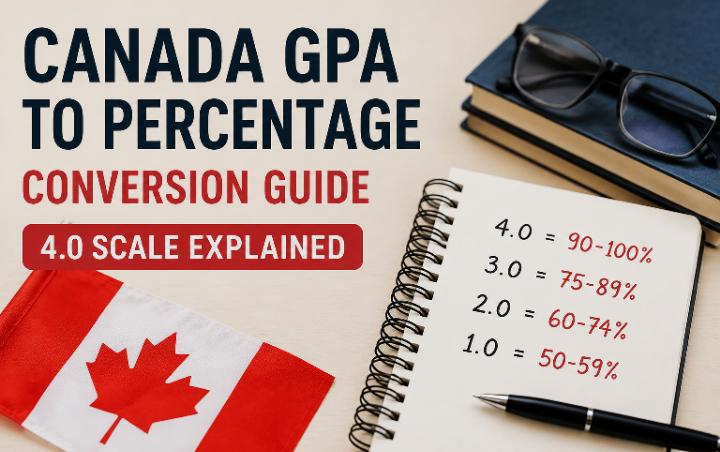
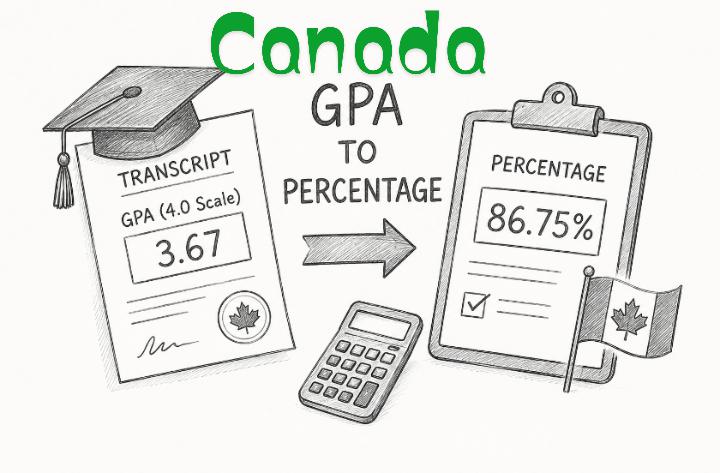
Canadian universities and immigration authorities typically request WES or ICAS evaluations for Indian credentials. A 10 CGPA with strong transcripts is highly competitive for Canadian graduate programmes and Express Entry immigration applications. Report your percentage using your university's official formula, attach official transcripts, and let the evaluator handle the conversion to the Canadian GPA scale.
| Country | Uses Percentage? | Uses GPA? | Accepts Transcript? | Evaluator |
|---|---|---|---|---|
| USA | Sometimes | Yes (4.0) | Yes | WES, ECE |
| UK | Yes | No (Honours) | Yes | Ecctis/NARIC |
| Germany | No | Uses own scale | Yes | APS Certificate |
| Canada | Sometimes | Yes (4.0) | Yes | WES, ICAS |
| Australia | Yes | No (7.0 scale) | Yes | AEI/Institution |
What to Submit Where — Application Checklist
| Situation | What to Submit |
|---|---|
| Indian Job Application | Official percentage using your university's formula + original marksheets |
| Study Abroad (USA/Canada) | Official transcripts + WES evaluation + self-reported GPA converted by WES |
| Study Abroad (Germany) | Official transcripts + APS Certificate + university calculates Zulassungsnote |
| Study Abroad (UK) | Official transcripts + percentage per university formula + Ecctis if required |
| Government/PSU Application | Percentage as per official formula, notarised if required + original certificates |
| Scholarship Application | Official percentage + letter from registrar confirming conversion formula if possible |
A Real-World Example: Priya's Application Problem
Consider a scenario that plays out every placement season. Priya graduated from a VTU-affiliated college with a perfect 10 CGPA. When she received her campus placement form, the field asked for percentage. She typed 100% — reasoning that 10 out of 10 must be 100%.
She cleared the aptitude test, performed well in interviews, and received a conditional offer. Two months later, during background verification, the employer's verification agency compared her submitted 100% against VTU's official conversion — which gives 92.5% for a 10 CGPA. The discrepancy triggered a query. Priya had to write an explanation letter and submit her VTU marksheets and the university's official conversion notification before the offer was confirmed.
The offer was ultimately not revoked — because 92.5% is objectively excellent and there was no intent to deceive. But the process cost her three weeks and significant anxiety during what should have been a straightforward onboarding. Had she written 92.5% from the start with a note citing VTU's official formula, none of it would have happened.
This scenario is not unusual. It repeats across thousands of applications every year, particularly among engineering graduates from VTU, JNTU, and Mumbai University whose official percentages are lower than students might intuitively expect.
Common Mistakes Students Make
- ❌ Assuming 10 CGPA always equals 100%. As this guide shows, it can be anywhere between 82% and 100% depending on your university.
- ❌ Using the CBSE formula for an engineering university. CGPA × 9.5 is a CBSE formula. Applying it to a VTU or JNTU transcript gives a number your university does not officially recognise.
- ❌ Trusting random online calculators. Most generic CGPA calculators use CGPA × 10 or CGPA × 9.5 without specifying which universities those formulas apply to. The output may be completely wrong for your institution.
- ❌ Using percentage from a marksheet that shows both CGPA and percentage. Some universities print a percentage on the marksheet that is already calculated by the university. If your marksheet shows both, always use the printed percentage — not a self-calculated one.
- ❌ Applying a newer regulation's formula to an older batch transcript. JNTU and similar universities have changed their formulas across regulation years. The current formula may not apply to your graduation year.
- ❌ Not verifying with the registrar before major applications. For scholarship applications, visa applications, and overseas university admissions, always get a written conversion confirmation from your university's examination or registrar office.
How to Get an Official Percentage Confirmation from Your University
For high-stakes applications — graduate admissions abroad, competitive scholarships, or government roles — self-calculating a percentage is not always enough. Here is how to get an official document:
- Visit or write to your university's examination branch or registrar's office.
- Request a conversion certificate or equivalence letter that states your CGPA, the official conversion formula, and the resulting percentage.
- Some universities provide this on letterhead with a stamp. Others may refer you to the official examination regulations document — get a copy of that as well.
- For online universities or distance programmes, the student portal often has a downloadable percentage certificate. Check your login dashboard before visiting in person.
- If your university has published the formula in its official gazette, academic handbook, or website, take a screenshot and save the URL. This can be submitted alongside applications as supporting documentation.
If you are applying to international scholarships like the Mastercard Foundation Scholars Program, having this letter ready in advance saves time during the document submission stage. Read our guide on the Mastercard Foundation Scholars Program for more on preparing your academic documentation for competitive scholarship applications.
Frequently Asked Questions
Is 10 CGPA always equal to 100%?
No. It equals 100% only at universities using the CGPA × 10 formula, such as Anna University, KTU, Pune University, and several others. At CBSE and Delhi University it converts to 95%, at VTU to 92.5%, and at Mumbai University to 82%.
Is 95% equal to 10 CGPA?
Only at universities using the CGPA × 9.5 formula. At CBSE and Delhi University, a 10 CGPA converts to exactly 95%. At other universities using different formulas, 10 CGPA converts to different percentages.
Can I write 100% on my CV if I have 10 CGPA?
Only if your university officially converts 10 CGPA to 100% — such as Anna University or KTU. For VTU, CBSE, and JNTU students, writing 100% would be inaccurate and could cause verification issues. Always use the officially calculated percentage.
Does WES convert 10 CGPA to a US GPA?
Yes. WES evaluates your original transcripts and converts your academic record to the US GPA scale. They do not simply multiply your CGPA — they assess marks, credit hours, and course structure. A 10 CGPA from a reputable Indian institution typically converts to approximately 3.8–4.0 on the US 4.0 scale.
Which formula should I use if I am unsure?
Check your university's official examination regulations or academic handbook. If you cannot find it, contact the examination branch or registrar's office. Never use a formula from a random online calculator without confirming it matches your university's official policy.
Is 10 CGPA good enough for international scholarships?
A 10 CGPA places you in the top academic tier globally. It is highly competitive for scholarships like the Commonwealth Scholarship, Chevening, and Mastercard Foundation. Academic performance is one component — scholarship applications also evaluate leadership, community impact, and career vision. Our guide on studying smarter abroad covers how to position yourself as a strong applicant.
What percentage should I report for a 10 CGPA from VTU on a government job form?
Report 92.5%, calculated using the official VTU formula: (CGPA − 0.75) × 10. Attach your marksheets and, if the form requires it, request a conversion certificate from VTU's examination branch.
Does my percentage affect my study abroad eligibility?
For most countries, yes — but it is filtered through the credential evaluation process rather than taken at face value. A 10 CGPA, regardless of which percentage it converts to in India, signals excellent academic performance and will be treated as such by international evaluators who understand Indian grading systems.
My marksheet already shows a percentage alongside my CGPA. Which one should I use?
Always use the percentage printed on your official marksheet. If the university has already calculated and printed it, that is your official percentage. You do not need to recalculate — and you should not use a different number on applications.
Are IIT CGPA scores converted using any of the above formulas?
No. IITs use their own internal grading system (CPI — Cumulative Performance Index on a 10-point scale) and do not have a standardised conversion formula. IIT graduates are generally advised to submit their transcripts directly and let receiving institutions interpret the grades. Most foreign universities and employers recognise IIT credentials without requiring a percentage conversion.
What to Do Right Now
If you have a 10 CGPA and an application to fill, here is exactly what to do:
- Identify your awarding institution and regulation year. Check your degree certificate, marksheet, or hall ticket.
- Find the official conversion formula from your university's examination regulations, academic handbook, or official website.
- Apply the formula to your CGPA and note the resulting percentage.
- Check your marksheet — if the percentage is already printed, use that number.
- For high-stakes applications, request a conversion letter or equivalence certificate from your registrar's office.
- On the application form, write your calculated percentage and add a brief note: "Per [University Name] official CGPA conversion formula."
A 10 CGPA is an outstanding academic achievement. The conversion formula does not diminish what you have accomplished — it simply translates your score into the language each application system understands. Whether your percentage comes out as 82% or 100%, what matters is that the number is accurate, officially supported, and clearly presented.
For a broader understanding of how CGPA conversion works across all Indian universities — not just for a 10 CGPA — our guide covering every Indian university's CGPA to percentage formula provides the complete reference. And if you want to see how your grade compares internationally, the CGPA Global converter gives you instant equivalencies across 50 countries.

Be the first to comment on this guide.
Leave a Comment
Comments are reviewed before appearing. Your email is never published.